An NFT, or non-fungible token, is a blockchain token with a distinct identity rather than units designed to be interchangeable. It can represent a collectible, access right or other item. Owning the token does not automatically grant copyright, permanent access to a file or a guaranteed resale price.
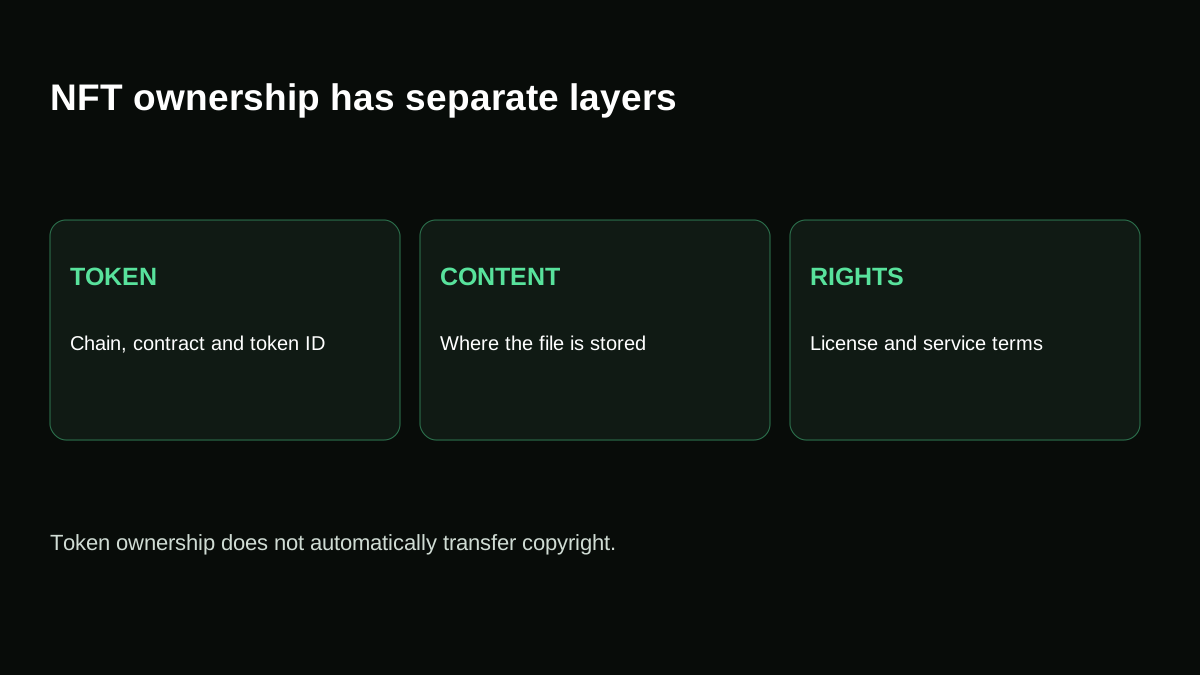
The most useful distinction is between three things: the on-chain token, the content or service associated with it, and the rights promised to its holder. Those can have different lifetimes and different sources of enforcement.
What “non-fungible” means
Fungible units are designed to substitute for one another within the same asset. An NFT has an identifier that distinguishes it from other tokens in its collection or contract.
Distinct identity does not establish artistic originality or economic scarcity outside that contract. Someone can create another token referencing the same image, or issue a separate collection with similar content.
Standards such as ERC-721 provide interfaces for identifying and transferring particular tokens. Other standards support different arrangements, including editions. The standard helps software recognize the asset but does not certify the creator's rights.
When inspecting an NFT, record the network, contract and token ID. The image and collection name alone are insufficient identifiers.
The image may live somewhere else
An NFT can reference metadata that points to an image, video or other file. Some content is stored on-chain; other content relies on external storage or hosting.
If external infrastructure stops serving the file, the token's ledger record can remain while the expected content becomes unavailable. Storage design therefore matters to long-term access.
A content-addressed link can help identify the file's contents, but continuing availability still needs appropriate hosting or persistence arrangements. Do not confuse an identifier with a promise that someone will keep serving the data forever.
Check whether metadata can change and who has that power. A collection may intentionally update artwork or access features, but the capability should be understood before purchase.
Ownership and copyright are different questions
Transferring an NFT records a change in token ownership. Copyright and licenses concern rights to use the associated work and depend on the actual terms and applicable law.
A buyer might receive only personal display rights, a defined commercial license or another arrangement. The creator may retain substantial rights. In some cases, the person minting a token may not have authority over the referenced work at all.
Read the license before relying on a plan to print merchandise, reproduce artwork or build a brand around it. A marketplace listing and a large price do not establish those rights.
For access-based NFTs, inspect the promised service separately. A blockchain token can remain transferable even if the operator stops running the game, membership program or event attached to it.
What a marketplace adds
A marketplace provides search, listings, offers and transaction tools. It may also label collections or restrict its interface. Those services are separate from the underlying token contract.
An item disappearing from one marketplace does not necessarily mean the token was deleted from the blockchain. Conversely, appearing on a marketplace does not prove authenticity or legal ownership of the content.
Inspect exact collection identifiers through verified creator channels. Copycat names and artwork can look convincing in search results.
Also distinguish a listing from a completed sale. A seller can ask a high price without finding a buyer. Your wallet's estimated collection value should not be treated as an executable offer for your specific item.
Buying and listing both involve permissions
Purchasing can require a payment transaction, token allowance or other authorization depending on the marketplace design. Listing may involve signatures that create executable orders or grant transfer capabilities.
Read the requested asset, amount, spender and scope. “List for sale” on a website is a user-interface label; the wallet request needs to match the intended sale.
Collection-wide approvals can affect more than one item. A compromised operator or harmful signature can create exposure beyond the single NFT you meant to handle.
Keep valuable holdings separate from unfamiliar application activity. If a request is unclear, cancel and consult official documentation rather than using the absence of gas as evidence of safety.
Pricing a unique item is difficult
Collection floor price usually describes the lowest available listing under a marketplace's current view. It is not necessarily the amount someone will pay for your item, and it can change when listings are removed or sold.
Offers, recent sales and trait differences can help provide context. None guarantees liquidity, particularly for a unique object with few interested buyers.
Account for marketplace fees, applicable royalties under the trading arrangement, gas and the route back into usable money. A headline sale amount is not the same as net proceeds.
If the reason for buying is enjoyment or access, evaluate whether that experience is worth the total cost without depending on resale. If the reason is speculation, acknowledge the possibility of no workable exit.
A compact ownership check
Before buying, answer four questions: which exact token is it, where does the associated content live, what rights are granted, and what continuing services does it depend on?
Add the transaction permissions and total cost. This reveals whether you are buying a durable on-chain object, access to an ongoing business or a speculative claim whose terms remain unclear.
Keep a copy of relevant license and service terms with the purchase record. Website changes can make later interpretation harder, even while the token's transaction history remains public.
FAQ
Can someone copy an NFT's image?
They may be able to copy the file, subject to applicable rights. Copying an image does not change ownership of the original token, while owning that token does not automatically prohibit every copy of the image.
Does burning an NFT remove the artwork from the internet?
Not necessarily. Burning affects the token under its contract rules. Copies of the associated content can remain elsewhere, and the exact consequences depend on the storage and licensing arrangement.
Are NFTs only digital art?
No. They can represent access, game items, credentials or other distinct records. Evaluate the particular implementation and issuer rather than assuming every use case has the same rights or market behavior.
Can I receive a scam NFT without asking for it?
Yes, an unsolicited item can appear at a public address. Its presence alone does not prove a key compromise. Avoid embedded redemption links and inspect actual permissions or outgoing activity if you suspect a problem.
Sources
Checked November 19, 2026: Ethereum NFT overview, ERC-721 standard overview, ERC-721 specification, and Ethereum security. Rights are arrangement- and jurisdiction-specific; no legal ownership opinion about a particular collection is offered. Related: airdrop risks.