A crypto airdrop distributes tokens to selected addresses or eligible participants, often to introduce a project or reward activity. Some distributions arrive automatically; others require a claim. Eligibility, token value and claim safety are separate questions, and none is guaranteed by the word “free.”
The first step is to identify who is announcing the distribution. An unexpected token in your wallet is not proof that you have received a legitimate reward or should visit a website to unlock it.
Why projects distribute tokens
A project may use an airdrop to broaden ownership, reward past users or encourage participation. Its announcement should explain who qualifies, what is distributed and what conditions apply.
Those intentions are not proof that the token has lasting utility or market demand. A distribution can generate attention without creating a useful product.
Some campaigns disclose criteria in advance; others assess historical activity. If a future reward is not confirmed, spending time and money to pursue it is speculation about a possible distribution.
Distinguish an announced allocation from a rumor promoted by an influencer. Ask for a verifiable project statement rather than treating a screenshot of someone else's eligibility as evidence for your account.
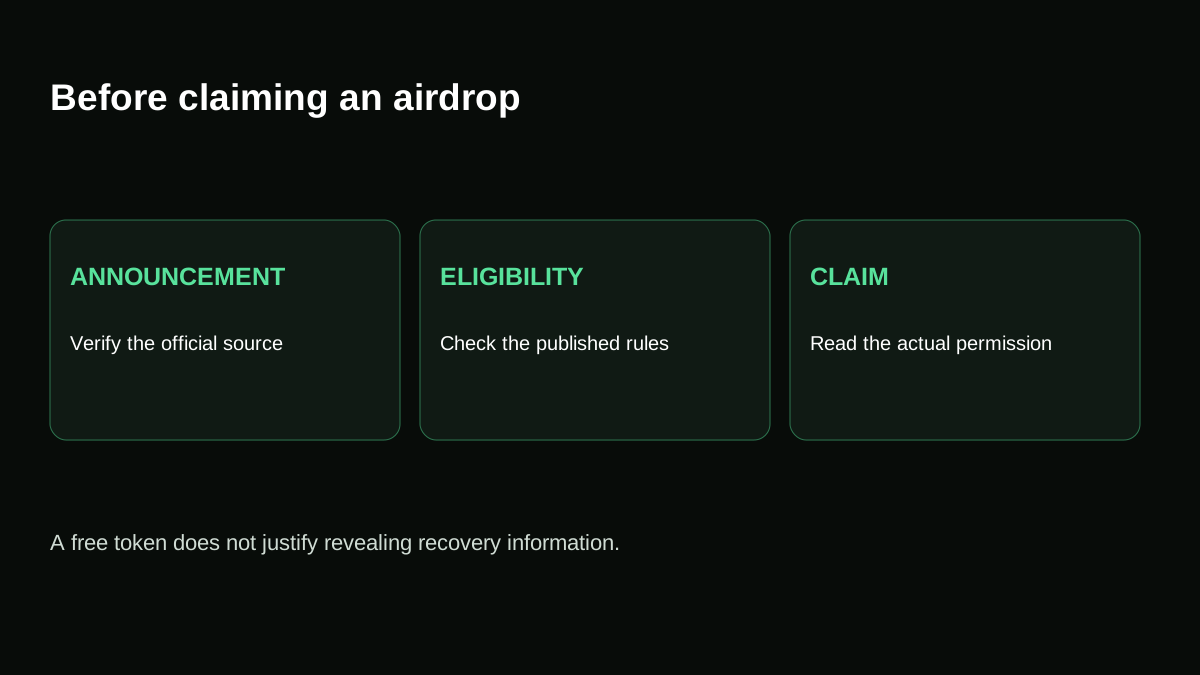
Eligibility does not require surrendering control
An eligibility checker can compare an address with distribution rules. Some allow public-address lookup without connecting a wallet. Others request a connection or signature, which must be assessed according to its actual purpose.
Knowing your address does not give a site legitimate reason to request your recovery phrase. No airdrop needs the secret that can recreate your entire wallet merely to determine whether an address qualifies.
If criteria involve historical use, check the relevant network, account and snapshot rules. A different wallet account or chain can produce a different result.
A “not eligible” result is not a problem that strangers can necessarily repair. Be cautious of paid services promising to alter a completed allocation or bypass the project's published conditions.
Claiming can involve a real transaction
A legitimate claim may require an on-chain call and network fees. That is different from sending an arbitrary payment to an address supplied in a private message.
Read the exact operation. A claim transaction should have a documented function and destination. If the prompt grants broad token spending or transfers an unrelated asset, investigate before authorizing it.
Signed messages also deserve attention. A signature can authorize consequential activity without an immediate gas charge. The absence of a fee does not prove the request is only a harmless login.
Use the project's verified instructions and supported wallet guidance. Do not rely on a website explaining its own suspicious request as “standard validation.”
Unexpected tokens can be bait
Anyone may be able to send tokens or NFTs to a public address under the relevant network's rules. You do not have to accept a personal relationship with the sender for an item to appear in a wallet.
Scam distributions may advertise a redemption site in their name or metadata. The displayed value can be unreliable or based on a misleading quote.
Simply noticing an unsolicited asset is different from interacting with its contract or following its links. Hiding or ignoring it is often preferable to experimenting with a claim, swap or removal transaction you do not understand.
An unsolicited balance is not, by itself, proof that your keys were stolen. Investigate actual outgoing transactions and permissions rather than panicking into the very website the sender wants you to visit.
Count the full cost of “free”
Costs can include gas, required activity, trading losses, time and privacy exposure. A campaign may link multiple addresses or require identity information under its terms.
Suppose an unconfirmed campaign encourages repeated transactions. Even if a token is eventually distributed, the value you can sell may be lower than the costs already incurred. There is also no guarantee an account will qualify.
For an announced claim, estimate the usable value and necessary costs. A wallet's displayed token price is not proof that you can sell the allocation at that price.
Tax treatment may also depend on jurisdiction and circumstances. Keep records of distribution dates, quantities and any disposal rather than assuming “free” means no reporting obligations.
A decision path for an actual announcement
Find the announcement through an established official channel you already trust. Independently confirm the domain and compare the published claim window and token details.
Check eligibility using the least-permissive method offered. Read the claim action before signing, including any network fee and token permission.
If the claim requires you to import your recovery phrase, pay an unexplained unlock charge or authorize unrelated assets, stop and verify through official documentation. Urgency from a countdown should not replace that verification.
After a legitimate claim, confirm the receipt on the correct chain and assess whether any permissions remain. Treat decisions to hold, sell or use the token as separate choices, not obligations created by receiving it.
FAQ
Does an airdrop mean I am an investor in the company?
Not automatically. Token ownership does not inherently confer shares, revenue or legal membership. Read the actual rights and terms instead of inferring them from the distribution.
Can a genuine airdrop require a network fee?
Yes, a claim transaction can incur gas. That does not validate every requested payment. Confirm that the fee is part of a documented network transaction rather than an arbitrary transfer to a promoter.
Can I guarantee a future airdrop by following a task list?
Only a project's clear, applicable commitment can establish stated conditions, and fulfillment can still involve risks. Unannounced rewards and influencer task lists are not guarantees of allocation or value.
Does disconnecting the claim website remove all permissions?
No. Connection state and on-chain approvals are different. Review any permissions actually granted using verified network-appropriate tools and guidance.
Sources
Checked November 19, 2026: Ethereum security, Uniswap guidance on unsolicited tokens and NFTs, Ethereum transactions and ERC-20 allowances. No current campaign or reward is endorsed here. Related: smart contracts.