Gas limit sets the maximum gas units a transaction may consume. Gas price describes the amount paid per unit; Ethereum's modern fee fields use a maximum fee and priority-fee limit. Raising the gas limit does not, by itself, buy faster inclusion. Quantity of work and price per unit are different settings.
The easiest way to read the screen is to separate three numbers: the maximum work allowed, the actual work used and the effective price paid for that work.
Use units before looking at dollars
Gas units measure transaction resources. Gwei is a denomination of ETH: one gwei equals one billionth of an ETH. A price expressed in gwei per gas unit is not the total transaction fee.
For a straightforward Ethereum execution-fee calculation, multiply actual gas used by the effective gas price. Then convert gwei into ETH. Additional fee components can apply on other networks or for particular transaction types, so do not assume this captures every possible quote.
The fiat equivalent is a further conversion using an ETH price. It can move independently of gas conditions, which is one reason screenshots of dollar fees age poorly.
Keep the native-unit calculation visible. It makes it easier to distinguish a change in resource cost from a change in ETH's market value.
A hypothetical calculation you can reproduce
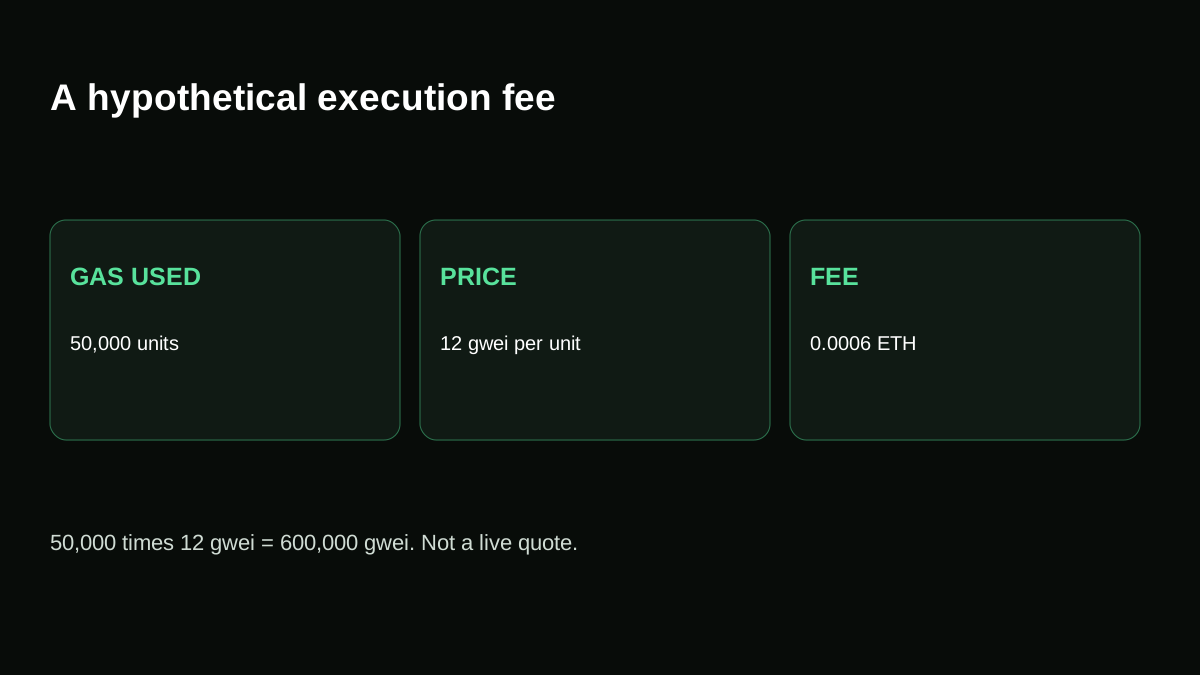
Assume an ordinary transaction uses 50,000 gas and its effective price is 12 gwei per unit. Its execution fee is:
50,000 × 12 = 600,000 gwei = 0.0006 ETH
Those inputs are illustrative, not current network quotes. If the gas limit had been 70,000, that would not mean all 70,000 units were automatically charged. Actual execution usage still matters, subject to the protocol's accounting rules.
Now suppose the transaction instead needs more work than the permitted limit. It can run out of gas, fail and consume the gas supplied. Reducing the limit below a sound estimate is not a reliable way to reduce cost.
The lesson is to use a reasonable estimate for the intended operation, then understand fee pricing separately. A contract action cannot be made cheaper merely by denying it the resources needed to complete.
Modern Ethereum fee fields
For EIP-1559-style transactions, the base fee is determined by protocol rules and changes with block conditions. The priority-fee setting limits the extra amount offered above the base fee. The maximum fee per gas caps the overall price you authorize.
In simplified form, the effective price is the lower of the maximum fee and the base fee plus the permitted priority fee, provided the transaction can cover the base fee. The actual priority component is constrained by the maximum cap.
This explains why a maximum is not necessarily what you pay. It also explains why a transaction can wait when its cap is too low for current conditions.
Wallets may show labels such as economy, standard or fast instead of every field. Read the wallet's explanation rather than assuming the same label means the same settings across products.
The maximum displayed amount and the final fee
A wallet may reserve enough balance for a worst-case authorized execution fee based on gas limit and maximum price. The final fee depends on what actually happens when the transaction executes.
You also need balance for any ETH amount being transferred. A transaction can fail preparation because the account cannot cover the transfer plus authorized costs, even if the expected final fee looks affordable.
Compare the maximum with the estimate and ask why they differ. A margin can accommodate changes in conditions; it is not automatically an extra service charge.
If the quote includes other network-specific components, inspect those separately. Layer 2 fee accounting and specialized transaction types can require more detail than a basic mainnet transfer example.
Common mistakes in advanced settings
Raising the gas limit to increase speed confuses resource allowance with inclusion incentives. An excessive limit can also affect whether a transaction fits network limits, so do not inflate it without a reason.
Lowering the gas limit to save money can cause failure if execution needs more work. A failed attempt may cost gas while achieving nothing.
Confusing gwei with ETH introduces errors of enormous scale. Check the unit next to each field before entering a number copied from a tutorial.
Using another network's settings assumes compatible economics where none may exist. Similar-looking wallet screens do not establish identical fee rules.
Repeatedly resending a pending action can create multiple requests or interact with account ordering. First identify the pending transaction and follow the wallet's supported replacement process if appropriate.
What to do when an estimate looks wrong
Check the network and requested operation. A simple token transfer can differ from an approval, swap or bridge transaction even when the same asset appears on screen.
Compare the request with the application's documentation. An unexplained contract call deserves investigation before you adjust its fee fields. A suspicious operation is not made safe by a lower gas setting.
If a simulation reports failure, investigate the cause rather than assuming the estimator is the problem. Token restrictions, insufficient balance or changed contract state can make execution fail independently of gas price.
For a transaction already submitted, consult its public status. Pending, reverted and successfully included are different outcomes. A wallet's stale notification should not be your only evidence.
FAQ
Is unused gas always lost?
For a transaction that completes using less than its limit, the unused allowance is not simply charged as completed work. Actual gas accounting can include protocol rules such as refunds; inspect the receipt for the recorded usage and effective price.
Does a 21,000 gas example apply to every ETH transfer?
A simple transfer between ordinary accounts is often illustrated that way, but contract interactions, account features and transaction details can change requirements. Follow the estimate for the actual operation rather than hard-coding a tutorial number.
Can a transaction stay pending with a high gas limit?
Yes. The price cap, current base fee, transaction ordering and validity can matter. A large resource allowance does not guarantee an attractive inclusion incentive.
Should a beginner manually edit gas fields?
Only after understanding the units, network and operation. Supported wallet estimates are usually a better starting point than copied numbers. Advanced settings provide control, not a shortcut around an invalid transaction.
Sources
Checked November 19, 2026: EIP-1559 fee specification, Ethereum gas and Ethereum transaction fields. All arithmetic uses explicitly hypothetical inputs. See gas fees for the broader cost comparison.