A gas fee pays for the resources used to execute a transaction on networks such as Ethereum. It is separate from the amount being transferred and from application or exchange charges. The cost depends on the work performed and the network's fee rules, not simply the transaction's dollar value.
That explains a confusing experience: moving a small amount can still carry a meaningful fee. Understanding the cost before signing is more useful than assuming a small payment should always be cheap.
Gas measures work; the fee pays for it
On Ethereum, gas is a unit used to measure computational work and related transaction requirements. The fee converts that resource use into an amount of ETH.
A simple native-asset transfer and a complex contract operation can require different amounts of gas. Network demand also affects the price paid per unit. You therefore need both the amount of work and its effective price to understand the final execution fee.
Wallets commonly show an estimate in ETH and a fiat equivalent. The fiat figure also depends on the conversion price used by the interface. It is an aid to understanding, not a separate amount paid to the network.
Other chains use different fee systems. “Gas” is widely used conversationally, but Ethereum's exact mechanics should not be applied to every blockchain.
Why the fee changes between transactions
There are two main questions: what operation are you performing, and what are network conditions when it executes? A contract with several interactions can consume more resources than a basic transfer.
The same type of action can also vary with contract state. An estimate is based on information available when the wallet prepares the request, not a universal fixed charge for that button.
Demand matters because execution capacity is limited. More users competing for inclusion can change fee conditions. A claim that one hour is always the cheapest is unreliable without current network evidence.
When an action is optional, you can inspect a fresh quote and decide whether to wait. When a deadline matters, compare the consequence of delay with the actual fee rather than making a blanket decision to choose the lowest setting.
What you need in the wallet to pay
On Ethereum mainnet, users normally pay gas in ETH. A wallet holding tokens may still be unable to send them if it lacks the necessary ETH balance.
Other networks have their own native fee assets or supported arrangements. Some services sponsor transactions or abstract the payment, but that is a feature to confirm for your particular route.
Before withdrawing tokens into a new wallet, plan the eventual outgoing transaction too. Receiving an asset and being able to move it later are different requirements.
Avoid sending more value to an address thought to be compromised merely to cover gas. If an attacker controls the signing credentials, fee funding can also be stolen. Establish the problem before adding money.
A failed transaction can still cost gas
If a transaction is included and execution reverts, the network has still performed work. The intended state changes may be rolled back while a fee is charged for resources used.
That differs from a transaction never included on-chain. A wallet error before submission, a dropped pending request and a reverted transaction are not interchangeable states.
Use the correct network's explorer to inspect the transaction record. Check whether it has a block and a failure status before deciding what happened. Repeatedly pressing the same button can add costs without resolving the cause.
For a swap, failure may relate to price conditions or contract restrictions rather than insufficient gas. Investigate the reason instead of simply raising every setting.
Separate network cost from the other charges
| Cost | Who or what determines it? | What to compare |
|---|---|---|
| Network execution fee | Blockchain fee rules and resource use | The actual operation and network |
| Exchange withdrawal charge | The exchange's terms | Asset, network and withdrawal amount |
| Application fee | Protocol or service design | The trade or action being performed |
| Spread or price impact | Market conditions and trade size | Final output, not only listed commission |
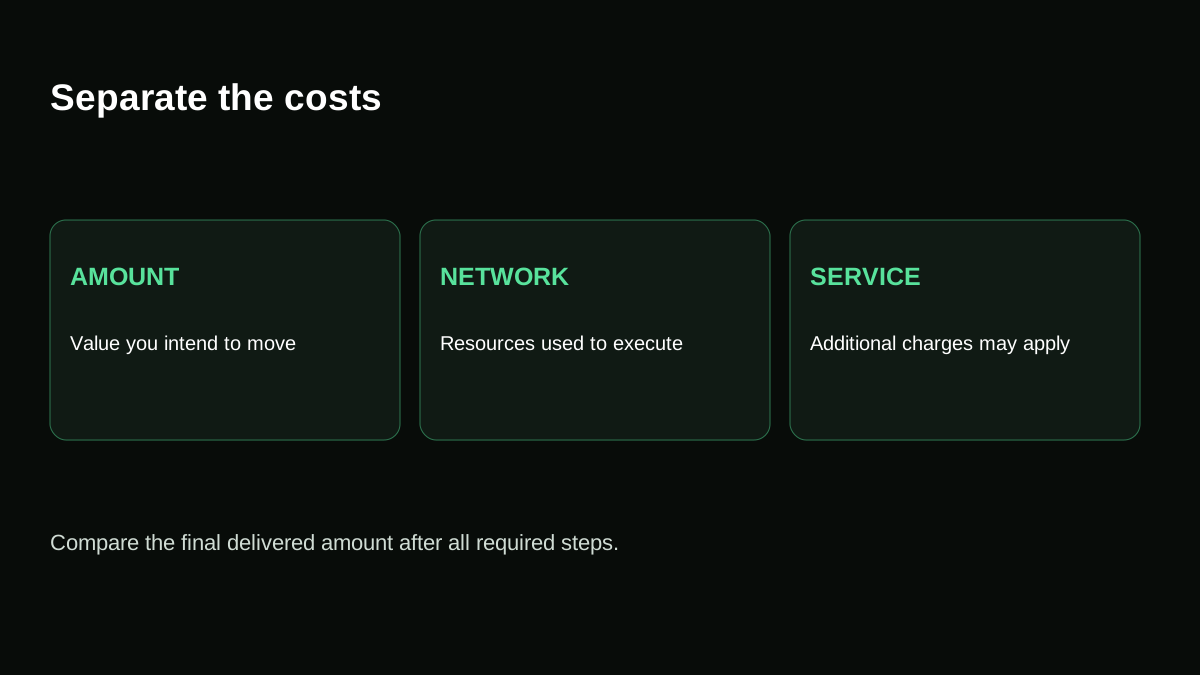
A low gas quote does not prove a trade is cheap overall. The route might have a poor exchange rate or additional charges. Equally, an exchange withdrawal charge is not a direct reading of the fee it eventually pays on-chain.
For a useful comparison, fix the starting amount and desired destination. Ask what ends up available at the end after all required steps. This makes two routes comparable even when their fee labels differ.
Ethereum mainnet and layer 2 quotes need separate reading
A layer 2 network can have a different fee structure and additional data-related components. Its quote may be lower for your action, but it is still a distinct network with compatibility and exit considerations.
Do not select it solely because a withdrawal dropdown shows a smaller charge. Confirm that the recipient supports the asset on that network and whether another transfer or bridge would be required afterward.
A low-cost first step can become an expensive complete journey. Include the cost of returning or moving elsewhere when that is part of your plan.
The right route is the supported one that fits the entire task, not automatically the one displaying the smallest isolated number.
Before you approve the fee
Confirm the network, intended action and asset being spent. Read both the expected fee and any maximum amount displayed. Verify that the transferred amount remains correct after the wallet reserves funds for costs.
For a tiny balance, check whether the operation still makes economic sense. A fee larger than the value moved can be technically valid while being a poor choice for your purpose.
If advanced settings are unfamiliar, consult the wallet's verified documentation. Learn gas limit and gas price before manually changing fields that control different aspects of execution.
FAQ
Is gas a tax paid to Ethereum's developers?
No. Fees follow the network's protocol rules. On Ethereum, the base-fee component is burned and the applicable priority component goes to the block proposer. This differs from an app developer charging a service fee.
Can I guarantee instant confirmation by paying more?
No. Higher fees can affect inclusion incentives, but network conditions, transaction validity, account ordering and other factors matter. No fee setting provides a universal instant-settlement guarantee.
Can I get a failed transaction's gas back from support?
Normally a network execution fee already consumed cannot simply be refunded by wallet support. A service may have its own compensation policy, but that is separate from reversing protocol fee accounting.
Why do two wallets show different estimates?
They can use different estimation methods, timing, safety margins or fiat conversion prices. Compare the same network and action and inspect the fields behind the headline figure.
References
Checked November 19, 2026: Ethereum gas documentation, transaction lifecycle and EIP-1559. No live fee is quoted; exact charges must be checked when preparing the actual transaction.