Liquidity describes how readily you can buy or sell an asset without substantially changing its price. For a particular trade, the relevant question is how much can execute near the quoted level on a venue you can use. Market capitalization and reported trading volume do not answer that alone.
A token can display a large wallet value while offering little realistic exit capacity. Understanding liquidity helps turn a headline price into an estimate of what a trade could actually deliver.
Start with buyers, sellers and the spread
On an order-book market, bids are offers to buy and asks are offers to sell. The best bid is normally below the best ask; their difference is the spread.
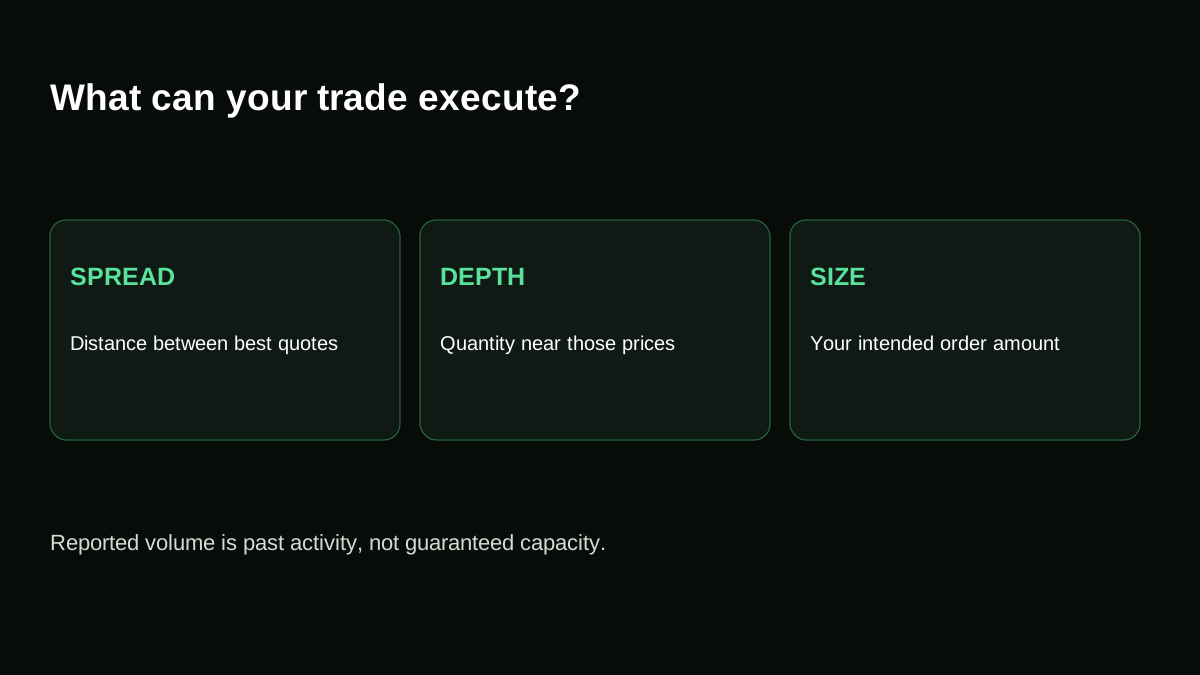
A narrow spread can be useful, but it describes only the closest prices. You also need to know how much is available there. A tiny order at an attractive level does not establish enough depth for a larger trade.
Think of the spread as the doorway and depth as the room behind it. A wide entrance does not tell you how many people can fit inside. Both measures matter for execution.
Check the exact pair. Liquidity in BTC/USD does not establish identical conditions in a smaller local-currency market or a different venue.
A market order can consume several price levels
Consider this hypothetical sell-side order book:
| Available quantity | Asking price per token |
|---|---|
| 100 tokens | $1.00 |
| 200 tokens | $1.02 |
| 500 tokens | $1.10 |
A market purchase of 400 tokens would consume 100 at $1.00, 200 at $1.02 and 100 at $1.10, assuming those orders remain available and no other conditions intervene.
The total is $414 before fees, making the average $1.035 per token. The top quote of $1.00 was not the price for all 400 units.
This is a teaching example, not a current order book. Its value is the method: add available quantities across price levels until your order is covered, then calculate the weighted average.
A liquidity pool solves the problem differently
An automated market maker uses assets supplied to contracts and a pricing design rather than only matching discrete limit orders. Your trade changes the relationship between assets in the pool.
Available liquidity around the active price affects how much a trade moves the quote. Some designs concentrate liquidity in ranges, so total pool value alone may not describe effective depth at your current price.
Inspect the expected output and price impact for your actual order. A pool holding substantial assets overall can still offer a poor route for a particular trade.
If an aggregator splits the trade across routes, evaluate the complete output after costs. Multiple routes may improve pricing but do not remove token, contract or network risks.
Price impact and slippage are related but different
Price impact is the change caused by your own trade interacting with available liquidity. Slippage is the difference between the execution you expected and what actually occurs, including changes while a transaction is pending.
Raising slippage tolerance allows a wider range of outcomes. It does not deepen the market or erase price impact. A warning that appears during a large swap should lead you to inspect the quote, not automatically relax the safeguards.
A limit order can set a price boundary on an order-book venue, but may not fill. A swap minimum-output condition can constrain the result, but the transaction can fail and still incur applicable network costs.
Choose the trade-off deliberately. Execution certainty and price control are not the same objective, and no setting gives unlimited quantities at a guaranteed market price.
Volume is historical activity; depth is available capacity
Trading volume reports activity during a period. Depth describes currently available orders or liquidity around prices. An active market yesterday can be shallow now.
Volume also needs scrutiny. Repeated or artificial trading can inflate activity figures without creating the exit capacity you need. A large aggregate figure may be concentrated on venues you cannot access.
Likewise, order-book depth is not a promise. Orders can be canceled before your trade reaches them, and market conditions can change rapidly.
Use these measures together, with timestamps. A useful comparison says which pair, venue, order size and time were examined. “High liquidity” without that context is a vague label.
Liquidity can vanish when you need it most
During market stress, participants may cancel orders, widen spreads or remove pool liquidity. A platform can also restrict deposits or withdrawals, affecting how easily arbitrage connects markets.
This means a position that looks easy to exit in calm conditions may be expensive to sell during a shock. Avoid planning around a single screenshot of a deep book.
For small or newly launched tokens, ask whether one pool or one group of holders supplies most accessible liquidity. A concentrated arrangement can be fragile even if the current quote looks normal.
The practical response is to consider plausible exit conditions before buying. If you need rapid access to the money for essential expenses, an uncertain exit is part of the decision, not an afterthought.
FAQ
Does a high token price mean high liquidity?
No. Unit price says little about available trading depth. An expensive unit can trade rarely, while a low-priced token can have active markets. Examine executable quantities and spreads.
Can dividing a trade into smaller orders always improve the result?
No. It may affect execution, but changing prices, repeated fees and information revealed to other traders can offset benefits. Compare actual routes and costs rather than assuming splitting is universally better.
Is liquidity the same as total value locked?
No. TVL can include assets committed to various applications and arrangements. It does not necessarily measure the amount available to execute your trade at a favorable price.
Can a wallet's displayed value be sold in full?
Only if sufficient compatible buyers or pool liquidity exist under workable transfer rules. The displayed valuation may use a quote that does not apply to your entire balance.
References
Checked November 19, 2026: Uniswap swap execution, price impact, price slippage and Coinbase trading rules. The book example is hypothetical and reproducible, not a claim of live market conditions.