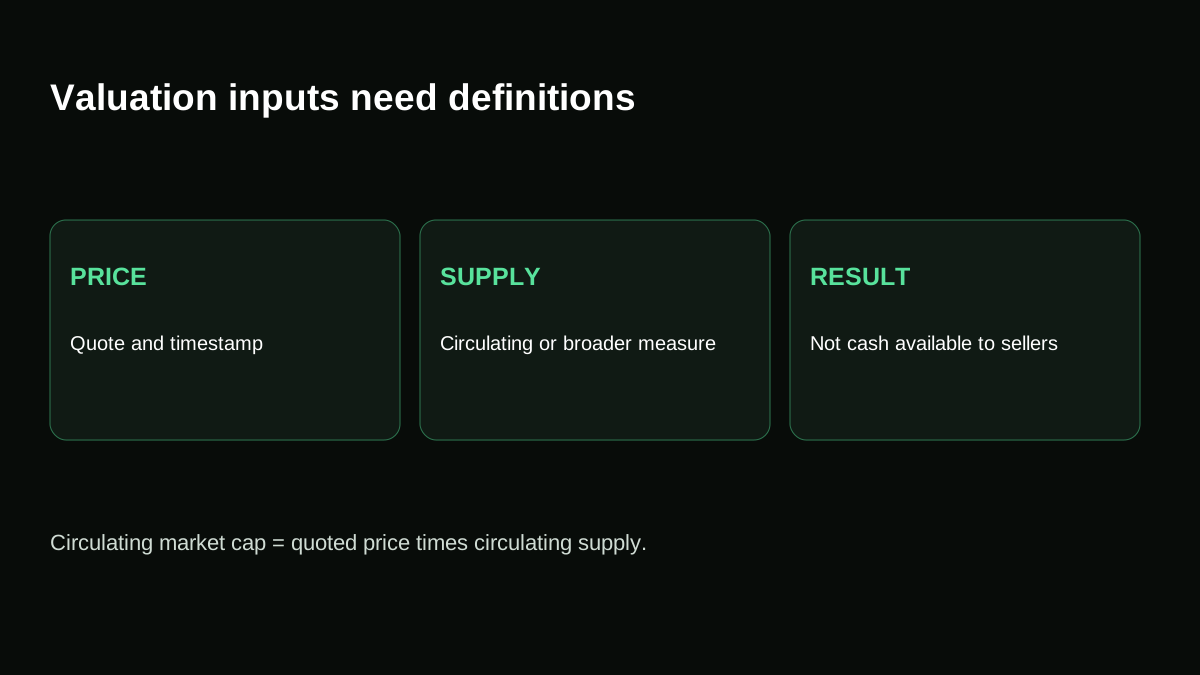
Crypto market capitalization usually equals a token's current price multiplied by its circulating supply. It estimates the market value of those circulating units at the quoted price. It is not the amount invested in the asset, cash held by the project or money every holder could withdraw.
The calculation is simple. Choosing the right inputs and understanding what they do not prove takes more care, especially for assets with small circulating supply or thin trading.
Calculate the number yourself
Suppose a hypothetical token trades at $2 and has 10 million circulating units:
$2 × 10,000,000 = $20,000,000 circulating market cap
Now compare a token priced at $0.02 with one billion circulating units. Its calculated capitalization is also $20 million. The lower unit price does not make the project automatically cheaper.
Neither hypothetical figure is a valuation recommendation. The examples show that supply and price must be read together. A token can be divided into more units without creating more underlying economic value.
When checking a website's number, record the price timestamp, quote currency and supply definition. Small differences between providers can result from using different inputs rather than a calculation error.
Circulating supply is an estimate with a methodology
Circulating supply attempts to identify units considered available in the market. Locked allocations, treasury balances, vesting and other restrictions can affect the figure. Providers do not necessarily classify every allocation identically.
Read the data provider's methodology and the project's supply disclosures. A missing or unverified figure should remain uncertain rather than being replaced with a confident guess.
The project's reported number also deserves scrutiny. Documentation can describe a schedule without proving how every address is controlled or whether a restriction is technically enforced.
For comparisons, use consistent definitions where possible. A table mixing one asset's verified circulation with another's self-reported total supply creates an apparent precision that the evidence does not support.
What fully diluted valuation adds
Fully diluted valuation, or FDV, multiplies the current price by a broader supply measure, commonly maximum or total supply depending on the provider and asset. Always inspect which measure is actually used.
If the example token has a maximum supply of 100 million units, multiplying by the same $2 price produces a $200 million FDV. That differs from its $20 million circulating capitalization.
The difference highlights potential future supply. It does not predict that every unit will enter circulation immediately or that today's price will survive unchanged as supply expands.
Check the release schedule, recipients and conditions. A large headline FDV is not a complete dilution analysis, while a low circulating capitalization is not automatically evidence of undervaluation.
Market cap does not measure money flowing in
A price can change after a relatively small trade, especially in a thin market. Multiplying that new price by every circulating unit can move calculated capitalization by much more than the cash involved in the trade.
For example, a token's calculated capitalization rising from $20 million to $30 million does not establish that $10 million entered the project. It reflects the chosen price and supply inputs at two moments.
Similarly, falling capitalization does not measure an equal amount of realized cash loss. Some holders may never trade during that period, while others execute at different prices.
Use actual flow or transaction data when the question is about money entering a fund, project treasury or trading venue. A capitalization chart answers a different question.
A price target needs an implied valuation check
When someone predicts a token will reach $1, multiply that price by a justified future supply estimate. Then ask what evidence supports demand at the implied valuation.
If a hypothetical asset would have 50 billion circulating units, a $1 target implies $50 billion in circulating capitalization. That arithmetic does not make the target impossible, but it exposes the economic scale behind an attractive-sounding unit price.
Avoid comparing the result mechanically with an unrelated company or cryptocurrency. Rights, revenues, utility, liquidity and supply dynamics differ. Similar capitalization is not proof of similar value.
A better note records assumptions explicitly: target price, supply at the relevant time, implied capitalization and reasons demand might support it. If the supply assumption is unknown, the target is incomplete.
Read capitalization alongside liquidity
A high calculated valuation can coexist with shallow order books or limited pool depth. The price used in the calculation may apply only to small trades.
Before buying or selling, examine the market available to you, the intended order size, spread and estimated execution. These determine the amount you might receive more directly than a global capitalization rank.
Also check concentration. A large share of supply controlled by a few parties can affect the market, but address counts require context because exchanges can hold funds for many users.
Capitalization is useful for scale and consistent comparisons. It becomes misleading when asked to establish safety, realizable exit value or a guaranteed path to a higher price.
FAQ
Does a large market cap mean an asset is safe?
No. It does not certify custody, code quality, legal rights or future demand. A larger market can still fall sharply or have risks unrelated to its size.
What if circulating supply is unavailable?
Treat circulating capitalization as unverified or unavailable. You can inspect other metrics with clearly labeled assumptions, but should not silently substitute total supply and keep calling the result circulating market cap.
Does burning tokens automatically increase market cap?
No. The calculation depends on both supply and price, and a burn's effect on reported circulation can vary. Demand and liquidity can move in the opposite direction.
Is FDV the amount needed to buy every token?
No. FDV applies one quoted price to a supply assumption. Buying all available supply would change execution prices, and some units may not be available for purchase at all.
References and method
Checked November 19, 2026: CoinGecko methodology and CoinGecko capitalization explainer. Calculations use invented, explicitly hypothetical inputs to demonstrate arithmetic, not original market data. Related: liquidity.