A smart contract is a program deployed on a blockchain that executes defined instructions when called. It can update records, move assets it controls and enforce programmed conditions. It is not automatically intelligent, legally enforceable or safe merely because its code runs on a blockchain.
The useful question is specific: what action will this program take with the permissions and information available to it? That is much more informative than a website saying the process is “trustless.”
Imagine a machine with explicit rules
A vending-machine analogy explains part of the idea: supply an accepted input, meet a condition and receive a programmed output. Unlike a physical machine, a blockchain contract's execution is checked through the network's rules.
The analogy has limits. Contracts can interact with other programs, rely on outside data and include administrative powers. A simple interface can hide a complex set of dependencies.
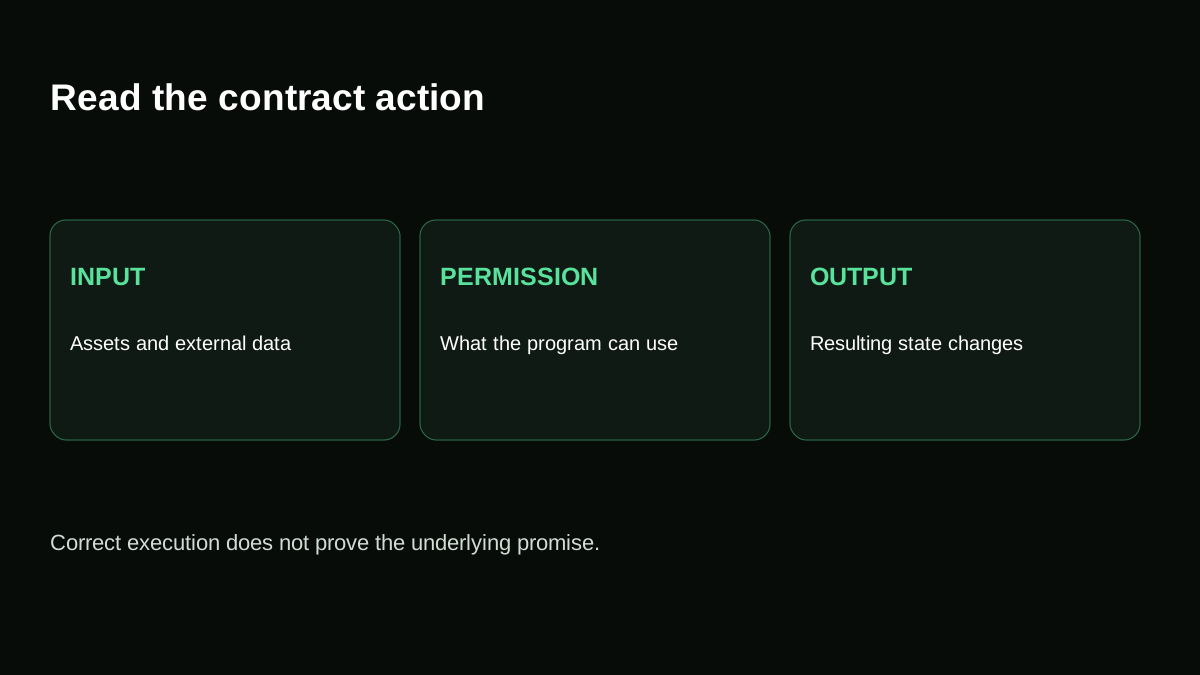
Suppose an application lets you exchange two tokens. The contract must know which assets are involved, how output is calculated and which transfers are permitted. A developer's marketing description is not the same as an exact account of those rules.
Before using a contract, identify the operation and the conditions for completing or reversing it. If you cannot explain where the assets go, the interface is not yet clear enough for a decision.
Calls can read information or change it
A user interface can read public contract information without requesting an on-chain transaction. For example, it might display a balance or quote. A state-changing action usually needs a transaction and applicable fees.
This distinction explains why viewing a quote can be free while executing it costs gas. The network must process and record the actual change.
Some applications also request signed messages. Not every signature is a transaction, but signatures can still authorize consequential actions. Do not treat a message as harmless just because the wallet does not show a network fee.
Read the request's meaning, domain and intended use. A request to prove account control should not be casually confused with an authorization to transfer assets or create an executable order.
Code can enforce the wrong thing perfectly
A blockchain can validate that execution followed the program while the program itself contains a bug or harmful rule. Technical correctness at the network layer does not establish a good outcome for the user.
A contract can also behave exactly as designed while the design favors an administrator. For example, a privileged role might change settings, pause functions or upgrade implementation code.
Ask whether such powers exist and how they are controlled. Multiple signers, delays or governance procedures can affect the risk, but none should be assumed from the word “decentralized.”
Public source code helps inspection. It does not ensure every user can evaluate it, nor does a verified-source label amount to an endorsement of the logic.
Outside facts need an outside-information mechanism
A contract does not inherently know whether a flight was canceled, a package arrived or a market price changed elsewhere. Systems use mechanisms often called oracles to provide relevant outside information.
That creates another dependency. You need to understand who supplies the information, how it is checked and what happens when it is delayed or incorrect.
A contract can enforce a payout condition flawlessly using bad input. Recording the result on-chain makes it inspectable, but does not transform an inaccurate external claim into truth.
For any application tied to real-world events, investigate both the execution rules and the information source. An impressive blockchain diagram is incomplete if it leaves that connection unexplained.
Permissions determine what a contract can reach
A token approval can authorize a contract to spend a specified asset within an allowance. Other account designs and signature schemes can grant different capabilities. The risk depends on the permission, not just whether your wallet is connected.
Inspect the spender, amount and purpose. A broad allowance may remain useful to the application but can increase exposure if that spender becomes compromised or behaves maliciously.
Revoking one permission removes that permission under the relevant token rules. It does not repair a leaked private key, guarantee recovery of already moved assets or invalidate every other signed authorization.
Keep the troubleshooting question narrow: did you reveal a secret, grant permission or execute a transfer? Those situations need different responses.
What an audit can tell you
An audit is a review with a defined scope, code version and methodology. It may identify problems and document fixes. It cannot establish that every future upgrade or surrounding business practice is safe.
Read whether the deployed contract matches the reviewed version and whether important findings remain unresolved. Check what dependencies were excluded and whether administrative controls were examined.
A badge alone hides these distinctions. So does a claim that a popular contract is safe because many people use it. Usage can show adoption, but vulnerabilities can remain undiscovered.
For a beginner, a helpful review explains concrete controls and limitations in accessible language. It should not require blind trust in the word “audited.”
A practical reading exercise
Choose a documented contract operation without funding it. Write down the asset supplied, expected output, permissions required and conditions under which the operation can fail.
Next, identify who can change important settings and whether an external data source is involved. Add the network and exact contract address to the note.
Compare this note with the wallet prompt or a public example transaction. Any unexplained mismatch is a reason to investigate before signing. This approach turns abstract contract education into a repeatable review of one actual action.
FAQ
Does a smart contract run continuously by itself?
Not in the everyday sense of a background employee. Actions generally require transactions or other triggering mechanisms supported by the system. Automated services can submit calls, introducing their own operational dependencies.
Can a smart contract be changed?
Some designs are fixed; others use upgrade mechanisms or configurable settings. Establish the particular design and who controls changes. “On-chain” does not answer the upgrade question.
Is a smart contract a legal contract?
Code execution and legal obligations are different issues. Whether an arrangement forms an enforceable agreement depends on its facts and applicable law. Do not infer legal rights from the technical label.
Can support reverse a contract transaction?
That depends on the contract's actual powers and the action involved. Do not assume a support team can undo a settled transaction. A claim that reversal requires your recovery phrase is a serious warning sign.
Sources
Checked November 19, 2026: Ethereum smart contracts, Ethereum transactions, ERC-20 permissions and security guidance. Related: gas fees.