Cryptocurrency is a digital asset whose ownership and transfers are recorded using a computer network and cryptography. Bitcoin is one example. You can hold crypto through a service or control it using your own wallet, but neither arrangement guarantees its value or protects you from every kind of loss.
The first useful question is not which coin to buy. It is what changes when money moves from a bank account into a crypto platform or wallet. Understanding that difference makes prices, passwords, fees and withdrawal screens much less confusing.
Think of crypto as three separate things
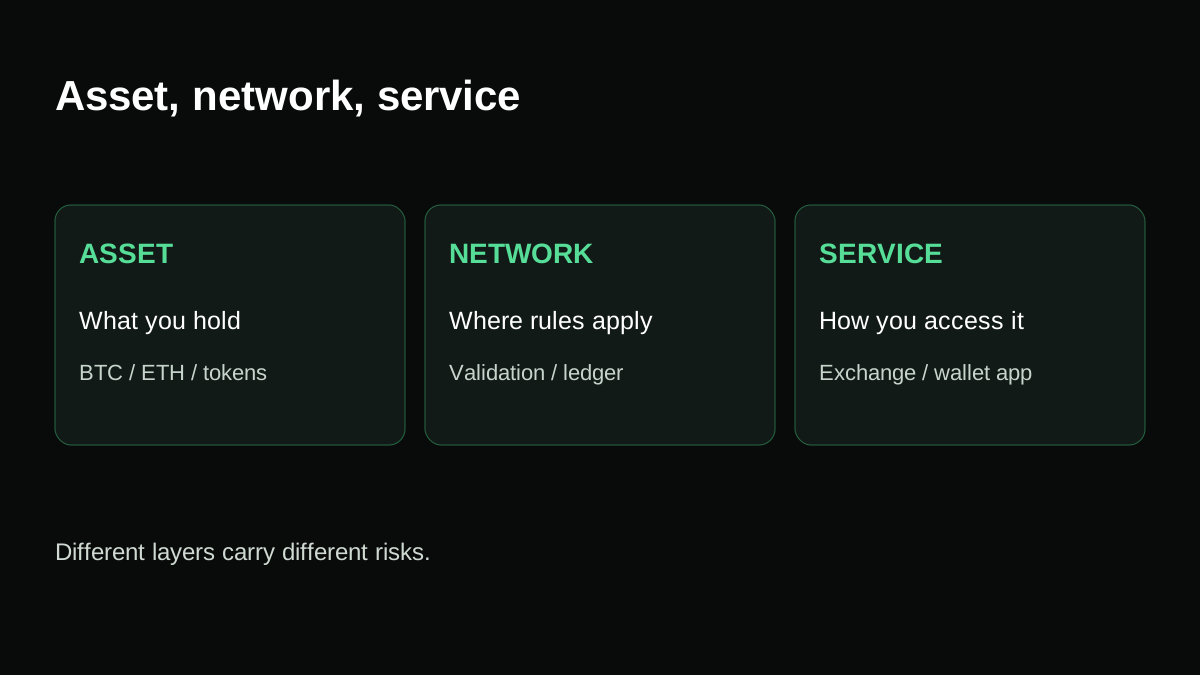
The asset, the network and the service are different parts of the experience. The asset is what you hold. The network maintains records and applies transaction rules. A service provides an interface, custody or a place to trade. A familiar logo may belong to only one of these layers.
Consider Bitcoin. BTC is the asset. The Bitcoin network validates its transactions. An exchange may let you buy BTC using your local currency. The exchange can experience a withdrawal problem while the Bitcoin network continues operating normally.
The reverse is possible too: a network can become congested while an exchange account remains accessible. Calling both situations “Bitcoin is down” hides the information you need to respond.
This separation also helps you read marketing. A platform saying it “supports Bitcoin” does not mean Bitcoin's developers endorse the platform. A token appearing in a wallet does not mean the wallet provider has investigated its issuer. Treat the relationships as separate claims requiring separate evidence.
How a cryptocurrency transfer works
A typical blockchain transfer involves an instruction, an authorization and a network record. Your wallet prepares an instruction identifying what should move and where it should go. A cryptographic signature authorizes the spend. Network participants check the transaction and, if accepted into the ledger, record its effects.
You do not email a digital coin as an attachment. The network updates which spending conditions or accounts control the relevant value. The wallet is the tool used to inspect and authorize those changes.
The blockchain is a shared record maintained according to network rules. Different cryptocurrencies use different designs, so Bitcoin's precise transaction model is not a universal diagram for every asset. For the underlying mechanism, read how blockchain works.
A transfer can involve several stages: prepared, broadcast, pending, included in a block and accepted by a receiving service. An exchange may require additional confirmations before crediting your account. “Sent” on one screen therefore need not mean “available to trade” on another.
Buying crypto does not always give you the same kind of control
When crypto stays in a custodial exchange account, the provider usually controls the keys used for blockchain transactions. Your login gives you access to the provider's system, subject to its rules and continued operation. With a conventional self-custody wallet, you control the credentials that authorize spending.
| Where you hold it | What you normally use | What you need to understand |
|---|---|---|
| Custodial exchange | Account login and security checks | Withdrawal rules, service availability and provider risk |
| Self-custody wallet | Wallet software and signing credentials | Backups, permissions and irreversible mistakes |
| Investment product tracking crypto | Brokerage account | Product structure, fees and whether withdrawals of actual crypto are possible |
These arrangements solve different problems. Someone uncomfortable protecting a recovery phrase should learn the responsibility before withdrawing to self-custody. Someone relying on an exchange should investigate the provider rather than assuming an account balance has the protections of a bank deposit.
For either route, ask: who can authorize an outgoing transaction, who can stop a withdrawal, and what happens if the app disappears? Those questions reveal more than the word “secure” on a homepage.
The main types of crypto you will encounter
Crypto is a category containing assets with different functions and risks. A useful starting distinction is between native network assets, tokens issued on a network and assets designed to track a reference value. Similar prices or names do not make them interchangeable.
Native coins belong to a blockchain's own economic system. Bitcoin uses BTC; Ethereum uses ether, commonly identified by ETH. Their rules and uses differ. Our Bitcoin introduction explains the first example in more detail.
Tokens are issued using an existing network's infrastructure. A token can represent application access, governance, a collectible or another claimed right. The actual rights depend on its code and legal arrangements. Possessing a token does not automatically give you shares, revenue or a claim on a company's assets.
Stablecoins aim to maintain a value relative to something else, often the US dollar. The word describes a target, not a guarantee. Reserves, redemption access, market liquidity and issuer controls matter. The Ethereum stablecoin overview explains why different designs should be evaluated separately.
Memecoins often trade around community attention and internet culture. A recognizable character or enthusiastic group does not demonstrate durable demand. More broadly, no category label substitutes for examining the particular asset.
Where does the price come from?
A traded cryptocurrency's price reflects what buyers and sellers agree to exchange at a particular venue and time. There is no universal authority promising to repurchase every coin at the number displayed in your app. Your actual execution price also depends on order size, liquidity and costs.
A price chart might show the latest trade. A purchase quote might include a spread or service charge. The amount you receive can therefore differ from a simple conversion using the chart price.
Here is a deliberately hypothetical calculation, not a market quote. If you pay $50 and a disclosed $1 purchase fee is deducted, $49 remains to buy the asset. If its price then stays unchanged, selling does not necessarily return $50: a selling fee, spread or withdrawal charge may still apply.
Before comparing two platforms, compare the same task. “Spend $50 from my bank and receive spendable crypto in my wallet” is a different task from “trade $50 already held on an exchange.” The advertised trading commission may cover only part of either journey.
What can you actually do with cryptocurrency?
People use crypto to transfer value, hold assets, pay participating merchants and interact with blockchain applications. Whether it is useful depends on the specific network, recipient, costs and local rules. Its availability around the clock does not make every transfer immediate or inexpensive.
For payments, both parties need compatible receiving arrangements. A merchant accepting BTC does not necessarily accept every token. A recipient expecting one network may be unable to access a transfer arriving on another.
For applications, the asset may pay transaction fees or interact with software called a smart contract. Using an application can introduce risks beyond simply holding a coin, including malicious permissions or faulty code.
Some people mainly speculate on price. That is a financial decision, separate from learning the technology. Understanding a network does not allow you to reliably predict its asset's short-term market price.
A practical way to identify what is on your screen
Before acting, identify five fields: asset, network, custody, action and total cost. This small routine helps you translate a busy interface into a decision you can inspect. If one field is unclear, pause at that field rather than guessing from the logo.
For example, “USDC” answers the asset question but may leave the network question unresolved. “Wallet” tells you the interface category but may not explain who controls signing. “Buy” may conceal a card purchase, a spot-market order or a broker quote with different costs.
Write the proposed action as a sentence: “I am buying this asset through this provider, paying these costs, and keeping it under this custody arrangement.” For a transfer, add the exact destination network. If you cannot complete the sentence, you have found the next thing to learn.
This is more useful than memorizing dozens of terms. It lets you ask a support team a precise question without sharing passwords or recovery information. It also makes two offers easier to compare on the same basis.
The risks are not all price risks
Crypto losses can come from market movements, provider failure, stolen credentials, dishonest projects and transaction mistakes. A strong password helps with account access but does not prevent an asset losing value. A well-designed blockchain does not guarantee that an exchange will honor a withdrawal.
Self-custody introduces another distinction: losing a device is not necessarily the same as losing access, provided a suitable recovery method exists. Losing both the device and the necessary recovery material can be much more serious. Recovery arrangements vary by wallet; learn yours before funding it.
Be particularly cautious when someone contacts you offering profits, account repairs or help “validating” a wallet. Treat a request for a recovery phrase as an attempt to obtain spending control. A public transaction record cannot force a dishonest recipient to repay you.
For a regulator's perspective on holding arrangements, see the SEC investor bulletin on crypto custody. Its US context should not be mistaken for a statement of protections in every country.
Frequently asked questions
Do I need to buy crypto to understand it?
No. You can inspect a public block explorer, read transaction examples and explore educational documentation without connecting a wallet. Learning first avoids turning every unfamiliar button into a decision involving money.
Does a cheap coin have more room to grow than an expensive coin?
The unit price alone cannot answer that. Supply matters, and a project can choose a very large number of units. Compare the asset's economic rights, circulating supply, future issuance and demand rather than assuming a price below one dollar means a bargain.
Is cryptocurrency the same thing as money in a payment app?
Usually not. A payment-app balance may represent a claim on a service tied to conventional money. A crypto product inside the same app can have different custody, withdrawal and legal terms. Read the terms for the specific balance rather than applying one account's protections to everything displayed.
Can learning about crypto guarantee I will avoid losses?
No. Learning can reduce preventable mistakes, but it cannot remove market uncertainty, undiscovered software problems or counterparty failure. A sensible first milestone is being able to explain what you hold and how it can be lost.
Sources and scope
Foundational references checked on November 19, 2026: Bitcoin.org: how it works, Ethereum wallets, Ethereum technical introduction, and the linked stablecoin and custody resources. No live price, fee quote or platform ranking is claimed here. The comparison questions and hypothetical cost example are explanatory tools, not investment recommendations.