Ethereum is a blockchain network that records transfers and runs programs called smart contracts. Ether, usually abbreviated ETH, is its native asset. People use ETH to pay network fees and help secure Ethereum through staking. Owning ETH does not mean owning shares in a company called Ethereum.
If Bitcoin first made you think about digital money, Ethereum adds another question: what if a shared network could also execute instructions for financial applications and other services? That is useful, but each application introduces its own assumptions and risks.
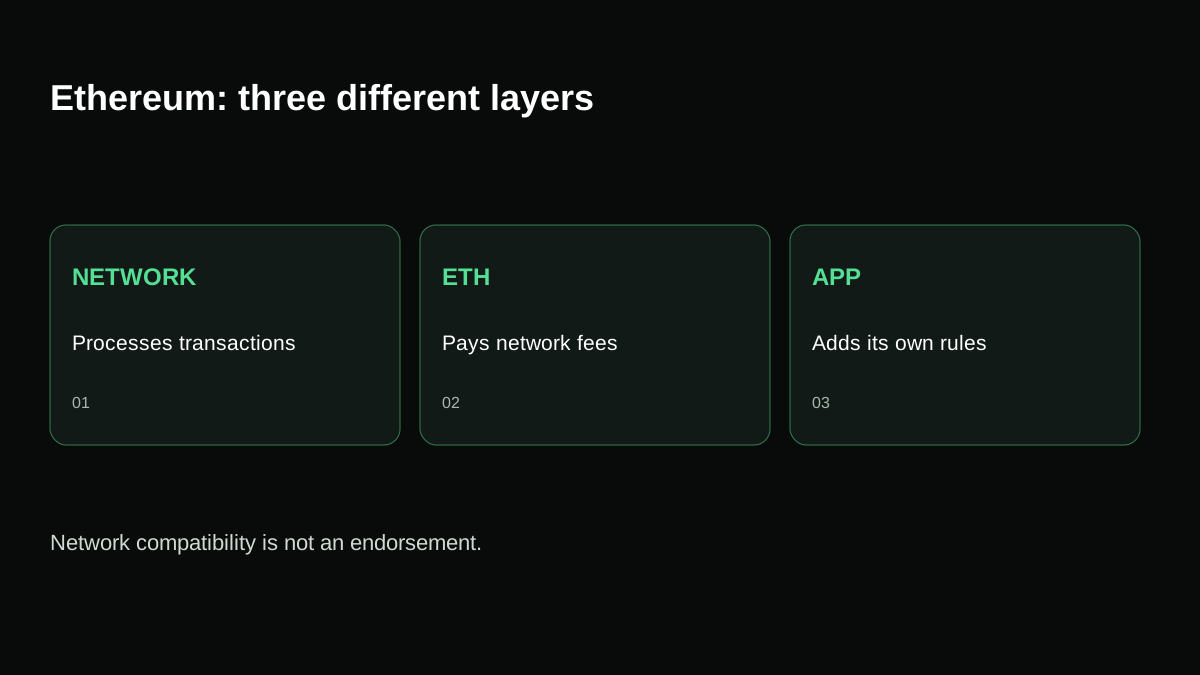
The network, the asset and the app are different
Ethereum provides infrastructure. ETH is the asset used within that infrastructure. An application is software built to interact with it. Keeping these three layers separate helps you understand what an app can legitimately promise.
An application might let users exchange tokens. Ethereum records the resulting transactions, but it does not investigate the application's business model or promise that every token offered is valuable. A familiar Ethereum logo is not an endorsement.
Similarly, buying ETH through an exchange gives you exposure to ETH, subject to that exchange's custody arrangements. It does not automatically give you an independently controlled Ethereum wallet. The distinction becomes important when you want to withdraw or use an application.
What a smart contract actually does
A smart contract is a program deployed on a blockchain. Users send transactions that call its functions, and the network checks the resulting changes. On Ethereum, a contract can keep records, enforce programmed conditions and interact with other contracts.
Imagine a simple exchange contract. Instead of an employee updating a private spreadsheet after each trade, the program applies its trading rules when a valid transaction reaches it. The practical question is whether those rules are correct and whether the transaction does what you expect.
The name “contract” can mislead. Code is not automatically a legally enforceable agreement. Nor is a program necessarily safe because its source is public. Bugs, upgrade permissions and connections to outside data can all affect its behavior.
For a beginner, identify the action before signing: are you transferring something, granting permission, depositing into a contract or approving a trade? These actions can have different consequences even when the same wallet confirmation window appears.
Why Ethereum transactions cost ETH
Executing transactions consumes network resources. Ethereum measures this work in gas and charges fees in ETH. A token can have a dollar value in your wallet while you still lack the ETH needed to move it on Ethereum mainnet.
A wallet's estimated fee is not the purchase price of the token. It is a separate transaction cost. More complex actions can use more gas than a simple transfer, and network demand affects the price paid for that work.
Also distinguish network fees from service fees. An exchange withdrawal charge is set by the exchange; it is not necessarily identical to the eventual on-chain fee. An application's trading fee can be additional again.
Before using an app, compare the entire action: the asset being spent, the asset expected back, any price tolerance, the network fee and any permission being granted. Reading only the large “receive” number misses much of the decision.
Where layer 2 networks fit
Ethereum layer 2 networks process activity using designs that rely on Ethereum for aspects of security or settlement. They can provide different costs and user experiences. They are distinct networks, with their own operational details and additional risks.
The same-looking address can appear on Ethereum and on another compatible network. That does not mean funds move automatically between them. A receiving exchange must support the particular asset on the particular network you select.
Before withdrawing, match the network shown by the sending platform to the deposit instructions supplied by the recipient. If you need to move value between networks, understand the bridge or transfer mechanism involved. Cheap fees alone do not establish compatibility.
Treat “uses Ethereum technology” and “settles on Ethereum” as claims needing clarification. Not every network with Ethereum-style addresses has the same relationship to Ethereum mainnet.
Staking is part of security, not a guaranteed savings rate
Ethereum uses proof of stake. Validators participate under protocol rules and commit ETH to the system. Rewards and penalties depend on their participation and network conditions.
A retail staking product can add other arrangements: pooled operation, a service provider, a liquid staking token or exchange custody. Those layers create risks beyond Ethereum's consensus mechanism itself.
For example, an advertised yield cannot tell you who controls withdrawals, what fees apply or whether you receive a different token. Ask those questions before comparing percentages. Holding ETH and using a staking service are separate decisions.
You do not need to stake ETH to receive it, learn about Ethereum or inspect public transactions. An educational article should not turn understanding a network into pressure to join a yield product.
A useful first exercise: inspect an action without signing
Read an app's explanation of one operation and write down what should change. Then compare that description with its contract documentation and a public example transaction. You can learn the relationship between interface, transaction and network record without funding an account.
Look for the network name and contract address. A token's name is not enough to identify the contract. Check whether the action involves an approval before the actual transaction, and whether that permission is limited to the intended amount.
If the description relies on unclear phrases such as “activate wallet” or “validate holdings,” stop at the missing explanation. A legitimate action should be explainable in terms of permissions, asset movements or a specific contract function.
Questions beginners often ask
Is Ethereum the same as ETH?
Ethereum names the network; ETH identifies ether, its native asset. People sometimes say they are “buying Ethereum” when they mean buying ETH. On a transaction screen, confirm the actual asset and network rather than relying on casual wording.
Can I use an Ethereum app through any wallet?
No. The wallet must support the relevant network and connection method. It must also support the signing arrangement the app requires. Check compatibility using the wallet's official documentation before connecting.
Does Ethereum support mean a token is legitimate?
No. A token can follow a technical standard while having dishonest promotion or dangerous administrative controls. Technical compatibility establishes how software can interact with it, not whether it deserves your money.
Do I have to buy a whole ETH?
No. ETH is divisible. Purchase minimums come from the service you use, while fees and withdrawal minimums may impose separate practical limits on small purchases.
References
Checked November 19, 2026: Ethereum overview, ether, smart contracts, and gas. This article explains concepts; it does not quote a live fee or staking return. Next: coin versus token.