A coin usually means a blockchain's native asset, such as BTC on Bitcoin or ETH on Ethereum. A token usually means an asset issued using an existing blockchain's infrastructure. The terminology is informal, but the distinction helps explain network fees, contract addresses and transfer compatibility.
It does not tell you which investment is better. A native coin can be risky, and a token can serve a legitimate purpose. Start with how the asset works rather than assuming one category deserves more trust.
A network can support more than its native coin
Ethereum has ETH as its native asset and also supports many tokens through smart contracts. Those tokens use Ethereum's infrastructure without becoming ETH. They can have different issuers, supply rules and administrative controls.
Think of infrastructure and assets separately. Sharing a road does not make every vehicle the same, and sharing a blockchain does not make every token an endorsement by that network's developers.
This distinction also explains why a token can fail while its host chain continues operating. The token's issuer, application or market can have problems unrelated to the validity of the chain's blocks.
Conversely, a functioning token contract depends on the network and interfaces used to access it. Evaluate both layers when deciding how to receive, store or move the asset.
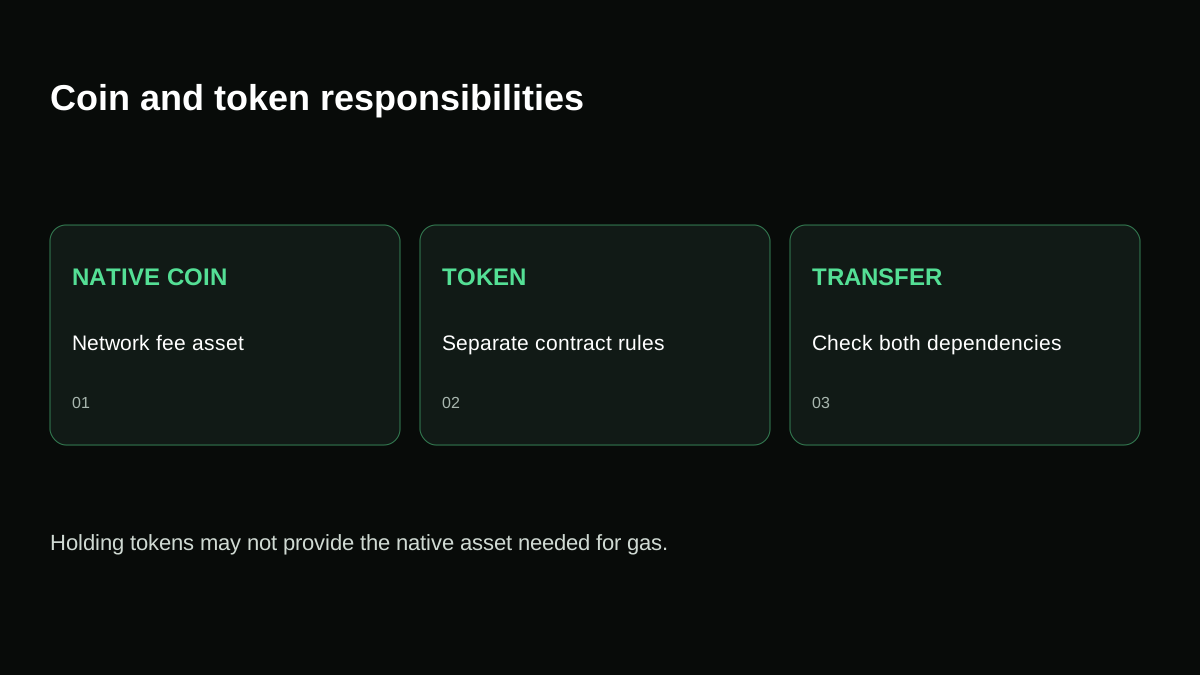
Why having a token balance may not let you move it
On Ethereum mainnet, transaction fees are paid in ETH. Holding a token with a displayed dollar value does not necessarily provide the ETH required for a transfer. You can have sufficient token units and insufficient native asset for gas at the same time.
Other networks use their own fee arrangements. Some applications or wallet services sponsor transaction costs, but that is an additional feature you should verify rather than assume.
Before receiving a token into self-custody, investigate how you would send it out again. Identify the native fee asset, expected transaction cost and a reliable way to obtain the amount needed.
Do not accept unsolicited “gas assistance” from a stranger who asks you to connect to a website or reveal recovery information. A missing fee balance is a practical problem; it does not require surrendering control of the wallet.
The asset identifier is more than a ticker
Native BTC on Bitcoin is identified through the Bitcoin network's rules. A token on an Ethereum-style chain is commonly identified by its contract address on that specific network. The name and symbol shown in an app are not enough.
Two contracts can use the same name. The same address text can also refer to different things on different networks. Always include the chain when documenting a token identifier.
For a first transfer, find the token information through official issuer documentation and match it to the receiving service's instructions. A logo appearing correctly in a wallet is not independent verification of authenticity.
Importing a custom token only changes what the interface displays. It does not create the token, approve its quality or make an unsupported deposit recoverable. This is a display operation, not a safety certificate.
What a token standard does
A standard such as ERC-20 describes a common interface for certain token functions. Compatible wallets and applications can use that interface to query balances and request transfers or spending permissions.
The standard helps software interact. It does not determine whether the issuer has useful reserves, whether demand is sustainable or whether contract administrators hold powerful privileges.
One important function involves allowances: a holder may authorize another address or contract to spend tokens under defined conditions. Granting that permission is different from merely connecting a wallet to a website.
Before approving, inspect the spender and amount. If a transaction request is unclear, the fact that the asset follows a popular standard does not make the permission harmless. Read the wallet's explanation and the application's documented operation.
Native, wrapped and bridged versions are not interchangeable
An asset represented on another network can depend on a bridge, custodian or separate issuance mechanism. A familiar ticker may conceal those additional dependencies. The representation can trade near the original asset while having different redemption and security arrangements.
For example, a token representing BTC on another chain is not native Bitcoin simply because its market price tracks BTC. Investigate how backing is established and how holders can return to the underlying asset.
“Wrapped” can also describe a contract-based representation of a native asset on the same chain. The precise mechanism matters more than applying one broad risk conclusion to every use of the word.
When transferring, verify the exact variant accepted by the recipient. A platform supporting an issuer's native stablecoin may reject a third-party bridged version using a similar name.
Follow the dependency chain
For a coin, inspect the network, custody arrangement and market. For a token, add the token contract, issuer or application, and any bridge or backing structure. More layers do not automatically mean a bad product, but they create more questions.
Write a short description before acting: “This is a token issued by this entity or contract on this network; I hold it through this wallet or provider; this is how I would exit.” Missing information becomes visible immediately.
Then test the proposed route against the recipient's instructions. A successful transfer requires compatible assets and networks, not merely similar labels on two screens.
This approach is especially useful when an exchange offers multiple withdrawal options. Start with recipient support, then compare costs among compatible routes. Reversing that order can turn a fee-saving decision into an access problem.
FAQ
Is Ethereum a coin or a token?
Ethereum is the network; ether, or ETH, is its native coin. People use “Ethereum” casually for the asset, but transaction decisions should identify ETH and the relevant network explicitly.
Can a token become a coin?
A project can launch its own network and arrange a migration from an earlier token. That requires a documented process. Do not assume old tokens automatically convert or follow migration links sent by strangers.
Are tokens cheaper to send than coins?
Not as a general rule. Costs depend on the network, transaction complexity, demand and service charges. A token transfer on a congested network can cost more than a native transfer elsewhere.
Does a contract address prove a token is safe?
It identifies a contract on a network. Safety depends on what that contract does, who can change it and the economic arrangements around it. Identity is necessary for research but not sufficient for a positive verdict.
References
Checked November 19, 2026: ERC-20 interface, Ethereum gas, ether and Bitcoin FAQ. Continue with crypto wallets to see how these assets appear in an interface.