A blockchain is a shared digital record organized into linked blocks. Participating computers check proposed changes against common rules, allowing them to maintain a history without relying on one database operator. Its security depends on the network's design and participants; the word “blockchain” alone proves little about a particular project.
To understand the technology, follow a transaction. You do not need to understand advanced mathematics first. You need to understand who proposes a change, who checks it, and why other computers accept the resulting history.
Start with the problem: agreeing on who can spend
Digital information is easy to copy. A payment system needs a way to distinguish a valid transfer from an attempt to spend the same value twice. A conventional database can assign that decision to its operator. A public blockchain distributes verification and uses a consensus mechanism to agree on an accepted history.
Imagine two instructions trying to spend the same available funds to different recipients. Both cannot succeed under the normal rules. The network needs more than a list of messages: it needs a consistent ordering and a way to resolve competing versions of that list.
This is why describing a blockchain as “a spreadsheet everyone shares” is incomplete. A spreadsheet analogy explains visibility, but not how participants handle dishonest updates or conflicting transactions.
The relevant questions are: what makes an instruction valid, how is it ordered, and what makes rewriting history costly or punishable? Different blockchains answer those questions differently. Bitcoin's blockchain developer guide provides one concrete implementation rather than a promise applying to every network.
Follow one transaction from wallet to record
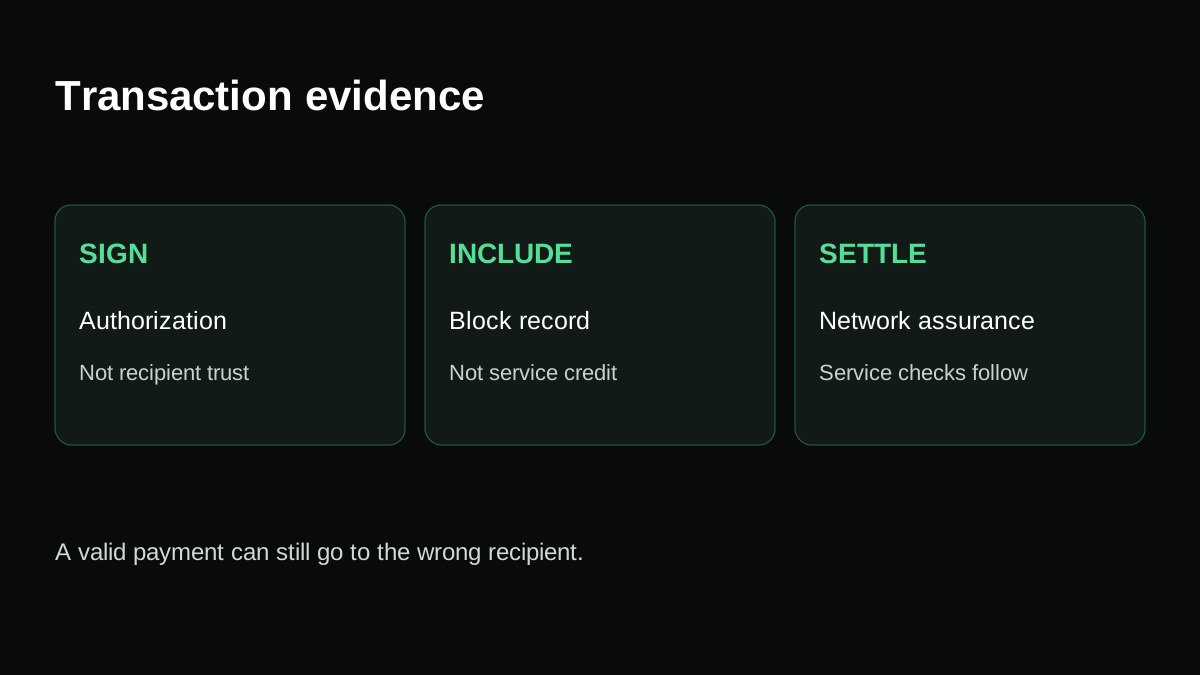
A transaction begins as a proposal. It becomes part of a blockchain only after the relevant network processes and accepts it. A wallet notification, an exchange email and an entry in a block are different pieces of evidence about that journey.
1. The wallet prepares and authorizes the request
The wallet constructs the transaction using information such as the recipient, amount and fee settings. Signing proves that the required authorization has been supplied without publishing the secret signing key. A valid signature does not prove the recipient is trustworthy or that the user understood the screen.
Think of the signature as answering a narrow question: does this request have the authorization required by the network's rules? It does not answer a consumer-protection question such as whether a merchant will deliver the promised goods.
2. The request reaches network participants
The signed transaction is sent to network nodes. Nodes are computers running software that communicates with peers and checks data. They can reject invalid requests and relay valid ones. A transaction visible to one node may not yet be visible everywhere.
Pending transactions may wait before inclusion. Their treatment depends on the network, fees and local policies. A pending list is not a guaranteed reservation in the next block.
3. A block is proposed and checked
An eligible block producer assembles a proposed block. Other validating nodes check whether its transactions and structure follow the rules. On a smart-contract network, checking a block also involves verifying the resulting changes to application state.
Who gets to propose blocks depends on the consensus mechanism. Bitcoin uses proof of work. Ethereum uses proof of stake. Neither design means an ordinary wallet user must personally produce blocks to receive a transfer.
4. The history gains confirmation or finality
Once accepted, the block extends the network's history. The strength of settlement depends on the chain's consensus rules and subsequent events. Some systems use increasing confirmation depth; others also have explicit finalization conditions.
A receiving exchange may apply its own confirmation threshold and compliance checks before crediting the customer. Blockchain inclusion therefore does not by itself establish that an exchange deposit is usable.
Why the blocks are linked
Blocks refer cryptographically to earlier blocks, making changes to earlier data detectable. A hash is a fixed-length result calculated from input data. Alter the input and the expected result changes. This linking helps nodes identify whether a proposed history fits together.
However, a hash is not a magic lock. An attacker can calculate a new hash for altered data. The difficult part is getting the altered history accepted under the network's consensus rules and overcoming the work, stake or other conditions protecting the existing history.
That distinction matters when you hear “blockchain is impossible to change.” A more accurate claim identifies which history, what confirmation state and what attack assumptions are involved. The security of a large established network cannot simply be assigned to a small chain using similar vocabulary.
Also, hashing does not automatically encrypt the original information. Public transaction details can remain readable even though cryptography protects their integrity. Privacy and tamper detection are separate properties.
Nodes, miners and validators do different jobs
Nodes verify and communicate data. Miners on proof-of-work networks compete to produce eligible blocks. Validators in proof-of-stake systems take on roles tied to staked assets and protocol rules. These terms overlap in everyday discussion, but their responsibilities are not identical.
In Bitcoin, a full node independently rejects blocks that violate the rules it enforces. A miner does not gain the ability to make an invalid transaction acceptable merely by discovering a proof of work. Mining and validation together explain more than the phrase “miners approve payments.”
On Ethereum, the software architecture includes execution and consensus clients. For a beginner, the important implication is that a blockchain node performs more than storing a downloadable copy of a ledger. Its software checks whether proposed updates are acceptable. See Ethereum's nodes and clients documentation for the implementation details.
Ordinary users often rely on wallet infrastructure to query the network. That is convenient, but it creates a service dependency: a wallet's data provider can fail even while the underlying chain continues processing blocks.
Proof of work and proof of stake, without the slogans
Consensus mechanisms help participants converge on an accepted history despite conflicting proposals. Proof of work uses computational work as part of that process. Proof of stake uses participating validators' economic commitments and protocol incentives. Both require careful rules beyond their names.
| Question | Proof of work | Proof of stake |
|---|---|---|
| What supports block production? | Repeated computation meeting a target | Validator participation under staking rules |
| What resources are relevant? | Mining equipment, energy and access to hashpower | Stake, validator operation and network-specific penalties |
| What should a user check? | Confirmation expectations and chain conditions | Finality conditions and validator/network conditions |
The table describes broad concepts, not a ranking. Implementation quality, concentration, software faults and operational conditions still matter. A claim that one mechanism makes every transaction safe omits the application and user layers.
Nor should “proof of stake” be confused with every product marketed as staking. An exchange yield product can involve custody and additional commercial terms. The underlying consensus mechanism does not explain the whole product.
What a blockchain record actually proves
A blockchain can provide evidence that a particular transaction was included under a network's rules. It does not automatically prove the human identity behind an address, the value of an asset, or the truth of a statement recorded by a user. Verification must match the question being asked.
Suppose a transaction shows a token moving between two addresses. That can establish the recorded movement. It does not establish that the token issuer has money in a bank account, that a business owns the advertised property, or that the transfer was economically independent of the sender.
Real-world claims require additional evidence. A token representing a physical asset needs trustworthy arrangements connecting the ledger entry to that asset. A smart contract reading a price feed depends on how the outside information reaches it.
This is the most useful boundary for beginners: a record can be internally valid while the story attached to it is false. Ask which claim is proven on-chain and which still depends on people, businesses or external data.
Public does not mean anonymous, free or equally decentralized
Public blockchains generally expose transaction activity to inspection, but that does not make every participant's identity immediately visible. Addresses can nevertheless become associated with identities through exchange records, public posts or other evidence. Treat pseudonymity as a limited property rather than a privacy guarantee.
Fees also exist because blockspace and execution resources are limited. Network design determines how costs are calculated. A chain being accessible at any time does not mean it has unlimited capacity or constant fees.
Finally, access and control are separate questions. A permissionless network allows participation under protocol rules; a permissioned system restricts participation through an administrator or approved membership. Both may use linked blocks, but users face different trust assumptions.
For a concrete project, investigate who operates the infrastructure, who can upgrade important contracts, and what happens if a central interface stops working. The label on the homepage cannot answer those questions.
Try a read-only verification exercise
Open a reputable explorer for an established blockchain and inspect an already confirmed transaction. No wallet connection is needed to view public records. Look for the transaction identifier, network, block, status, timestamp and fee. Distinguish the explorer's labels from the raw transaction evidence.
Then ask three questions. Is the transaction on the network you intended to inspect? Is it included rather than merely pending? Does the record show the asset and destination you expected?
An exchange screenshot cannot replace this check when the question concerns an on-chain transfer. Conversely, an explorer cannot show every internal accounting action inside an exchange. Matching the tool to the question is the practical skill this exercise develops.
Frequently asked questions
Is every distributed database a blockchain?
No. Databases can be distributed without grouping records into cryptographically linked blocks or using the same consensus arrangements. Blockchain is one design family, not a synonym for all shared data systems.
Can blockchain make incorrect information true?
No. Recording an incorrect claim can make its history easier to inspect without correcting the claim itself. Product authenticity, ownership of physical goods and real-world identities still need suitable verification outside the ledger.
Why can two block explorers display different information?
They may be indexing different networks, updating at different speeds or applying different labels. Compare the exact transaction identifier and chain first. A missing search result on one interface is not sufficient evidence that a transaction never occurred.
Does a blockchain keep every file belonging to an NFT?
Not necessarily. An NFT can reference content stored elsewhere, while only token ownership or metadata references are recorded on-chain. Inspect the storage arrangement before assuming the image or other content will remain available permanently.
References
Checked November 19, 2026: Bitcoin blockchain, Bitcoin mining, Ethereum blocks, Ethereum consensus mechanisms, and the node documentation linked above. The transaction walkthrough is a conceptual explanation, not a claim that every chain uses identical processing. Next: what Bitcoin is.