Bitcoin is a digital currency and payment network that lets people transfer value without a central payment operator. Its asset is called bitcoin, usually abbreviated BTC. You can own a fraction of one bitcoin, and controlling it means being able to authorize spending under the network's rules.
If that still sounds abstract, start with a practical distinction: Bitcoin is the network, BTC is the asset, and your exchange or wallet is a tool for using it. Understanding those three parts makes the rest much easier.
What makes Bitcoin different from an ordinary account balance?
A conventional payment account depends on an organization maintaining its customer ledger. Bitcoin uses a public network whose participants check transactions against shared rules. With self-custody, you can authorize a transfer using your signing credentials rather than asking a bank to update its internal records.
That does not mean every way of buying BTC removes intermediaries. If you leave it on an exchange, that company normally handles custody and withdrawals. You have chosen a service relationship in addition to exposure to Bitcoin's price.
Nor does direct control mean easy recovery. If a transfer is valid and settles to an unintended recipient, there is no Bitcoin customer-service office that can simply reverse it. A recipient might voluntarily return it, but the network does not provide a card-style chargeback process.
The benefit and responsibility come together. You can have control without a central account provider; you must also understand how you will protect and recover that control.
Bitcoin, BTC and satoshis: the units you need
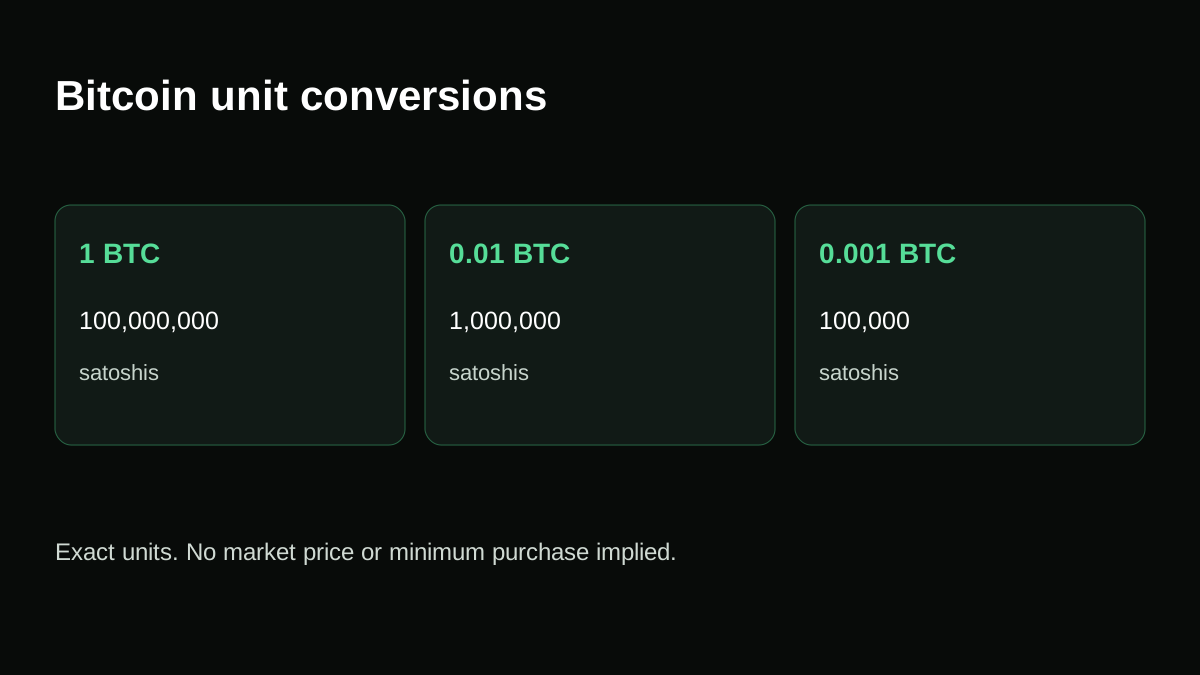
Bitcoin is divisible. One BTC equals 100,000,000 satoshis, often shortened to sats. You do not need enough money to purchase a whole bitcoin. The price of one unit is a quotation convention rather than a minimum entry requirement.
| Amount in BTC | Amount in satoshis |
|---|---|
| 1 BTC | 100,000,000 sats |
| 0.01 BTC | 1,000,000 sats |
| 0.001 BTC | 100,000 sats |
| 0.00001 BTC | 1,000 sats |
These are unit conversions, not current market values. To estimate a purchase, divide the amount available after fees by the quoted price per BTC. Your actual result depends on the execution price and the platform's charges.
For example, if a hypothetical purchase allocates $20 after fees and the hypothetical price is $100,000 per BTC, it buys 0.0002 BTC, or 20,000 sats. Neither number is a live quote. The example simply shows why a high whole-coin price does not prevent fractional ownership.
Small amounts still need cost planning. A withdrawal charge can consume a large percentage of a tiny balance. Minimum purchases, minimum withdrawals and blockchain transaction costs are different constraints.
How a Bitcoin payment travels
A Bitcoin wallet prepares a transaction spending available transaction outputs to new destinations. The required signatures authorize the spend. The network checks that the transaction obeys its rules, and a miner may include it in a block. More blocks after that generally make reversal by chain reorganization less likely.
The wallet usually handles the technical accounting. You see an amount and a recipient address, rather than manually selecting the underlying records. Nevertheless, Bitcoin does not simply subtract from a single universal account number in the same way as a basic banking illustration.
One consequence is change. A transaction can include a payment output and another output returning the remainder to the sender's wallet. An unfamiliar second output is therefore not automatically evidence of theft. You need the transaction context.
Another consequence is fee calculation. On-chain fees are related to transaction size in virtual bytes and the selected fee rate, rather than being a universal fixed percentage of the value sent. A small-value payment can still involve a meaningful fee. Bitcoin's transaction documentation explains the underlying structure.
For a new user, the operational lesson is straightforward: review the wallet's complete confirmation screen, including destination, amount and total cost. Do not assume the price of BTC alone tells you the cost of sending it.
Why miners exist—and what they cannot do
Miners compete to produce blocks using proof of work. Successful block production can earn a subsidy and transaction fees, subject to the network's rules. Mining helps establish transaction ordering and makes rewriting accepted history costly. It is not a requirement for owning or receiving BTC.
Full nodes independently check proposed blocks. A miner cannot make counterfeit BTC acceptable to those nodes merely by using powerful equipment. The block must meet the rules the receiving nodes enforce.
This division explains why “miners control Bitcoin” is an incomplete description. Miners, node operators, developers, businesses and users play different roles. Changes to software do not automatically force every participant to accept changed rules.
It also explains why a website promising “mining income” should be assessed as a separate business offer. Bitcoin's technical design does not establish that the website owns equipment, pays customers honestly or operates profitably.
The supply limit does not set a price floor
Bitcoin's existing consensus rules limit issuance to roughly 21 million BTC, with the block subsidy declining through scheduled halvings. Scarcity is a supply property. It does not require buyers to pay a particular price or guarantee that demand will keep increasing.
The halving occurs according to block height rather than a guaranteed calendar appointment. A headline about a future date is an estimate based on block production, not the exact rule itself.
Coins already issued are not all necessarily available for sale. Some owners hold long term; some signing keys may be lost. Estimates about inaccessible coins are not a directly verifiable universal balance sheet.
For beginners, avoid turning any of these observations into a mechanical price forecast. A known supply rule can coexist with sharp changes in demand, market liquidity and the price someone will pay today.
A wallet stores access, while the network records the coins
A Bitcoin wallet manages information used to receive and spend BTC. The asset is represented in the network's ledger rather than physically contained in the phone. Replacing a broken device can be possible if the necessary recovery arrangements remain intact.
Many wallets use a recovery phrase, but wallet designs differ. Some arrangements use additional passphrases, multiple signers or other recovery mechanisms. Learn the exact requirements of your setup; “I have a backup” is too vague until you know what it restores.
A receiving address can be shared so someone can pay you. A private key or recovery phrase can confer spending control and must be treated differently. Someone asking for recovery words to “verify a payment” is asking for information the payment itself does not require.
Also separate the wallet's local unlock password from the underlying recovery credentials. Changing an app password does not necessarily protect funds after someone has obtained the credentials that can restore and spend the wallet elsewhere.
Check whether a product actually gives you bitcoin
Owning native BTC, holding an exchange balance, buying a wrapped token and buying a price-tracking investment product are different arrangements. They can all expose you to Bitcoin-related prices, but they do not provide identical redemption rights, custody responsibilities or transfer capabilities.
Before purchasing, ask what you will receive and where it can be withdrawn. A service offering BTC withdrawals to the Bitcoin network is describing a different capability from a brokerage product that can only be bought and sold for cash.
A wrapped representation on another blockchain introduces its own mechanism for representing BTC. The token's presence on that other network does not make it native Bitcoin. You need to understand how the backing or redemption works and who or what controls it.
This distinction is especially useful on withdrawal screens. Familiar ticker symbols can appear alongside several networks. Choose an arrangement supported by the recipient, and do not interpret a cheaper option as proof of compatibility.
How to tell price exposure, ownership and usability apart
Use three separate questions when evaluating a BTC service. First, does the product's value move with BTC? Second, what rights do you have to obtain or spend the underlying asset? Third, can you use it through the payment route your recipient accepts? A “yes” to the first does not answer the other two.
Someone buying a brokerage product may want only price exposure. Someone paying a Bitcoin invoice needs a compatible payment method. Someone building a personal reserve must decide how custody and recovery will work. These users may reasonably choose different tools.
Bitcoin's Lightning Network adds another distinction. It supports a different payment route built around Bitcoin, using payment channels. A Lightning invoice and an ordinary on-chain address are not interchangeable instructions. Wallet support and custody can differ as well.
For your first learning exercise, inspect a public Bitcoin transaction without moving money. Identify its transaction ID, block and outputs. You will understand the evidence behind “confirmed” before needing to rely on it for a payment.
Risks to understand before buying
Bitcoin's price can fall substantially. An exchange can impose restrictions or fail. Self-custody credentials can be stolen or lost. A payment to a fraudster can be technically valid. These risks occur at different layers, so one security measure cannot solve them all.
Do not use the word “decentralized” as a substitute for evaluating a particular business. Check the actual provider, jurisdiction, costs, withdrawal process and custody terms. A smooth purchase interface says little about what happens during a dispute.
Do not rush because a stranger predicts a short deadline or guaranteed return. Education should give you room to make a decision, including the decision to hold no BTC. Read Bitcoin.org's user cautions alongside any explanation of the technology's advantages.
Frequently asked questions
Who created Bitcoin?
The design was introduced under the name Satoshi Nakamoto in a 2008 white paper, and the network began operating in 2009. The name is a pseudonym; claims to know the creator's identity require evidence beyond simply repeating a name online.
Do I need mining equipment to receive a payment?
No. You need a compatible receiving arrangement, such as a wallet or supported service. Mining is a block-production activity with separate equipment and economic considerations.
Is a physical Bitcoin coin actual BTC?
A souvenir bearing the Bitcoin logo is not automatically spendable bitcoin. Any claim that a physical object controls BTC depends on how signing access is supplied and whether someone else may retain that access. The logo has no spending power.
Can support staff reset a self-custody Bitcoin wallet?
They may help you understand the software, but they cannot normally replace missing signing credentials for a conventional self-custody setup. Recovery depends on the arrangements established before access was lost. Never send recovery words to someone claiming to perform a reset.
Sources and further reading
Checked November 19, 2026: original Bitcoin white paper, Bitcoin FAQ, wallet developer documentation, mining documentation, and the transaction and caution pages linked above. No current BTC price, guaranteed confirmation time or future return is asserted. For the broader category, return to cryptocurrency for beginners.