A decentralized exchange, or DEX, enables crypto trading through blockchain-based protocols rather than relying entirely on a conventional exchange's internal custody and matching system. Users commonly authorize trades from their own wallets. They still depend on the specific contracts, assets, liquidity and interfaces involved.
Self-custody changes who controls access to your assets. It does not make every token legitimate, every quote competitive or every transaction reversible.
The website is not the whole exchange
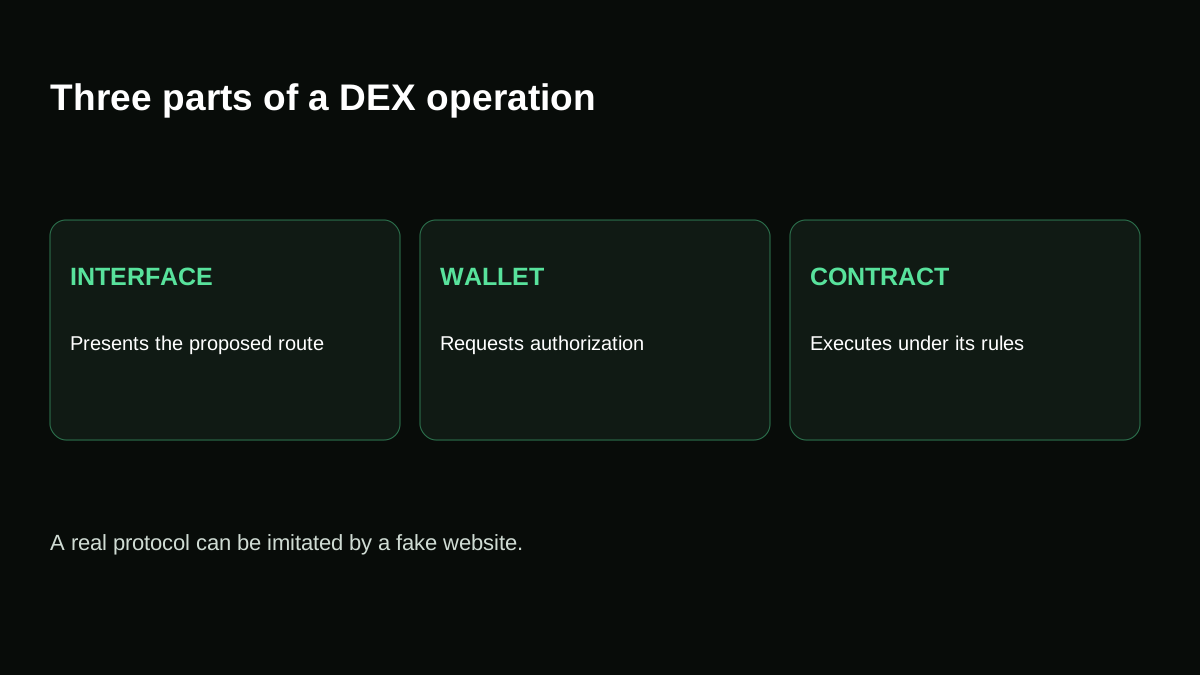
A DEX experience can involve a website, a wallet, routing software and one or more smart contracts. The website presents choices; the wallet requests authorization; contracts execute the operation under their rules.
A fake website can imitate a legitimate protocol. An authentic interface can also route a transaction across several pools. Knowing the brand name is therefore not enough to understand the action.
Verify the official domain through trusted sources and inspect the selected network. A service calling itself a DEX may use additional centralized infrastructure or impose interface restrictions.
Read “decentralized” as a prompt for further questions: who can upgrade contracts, pause functions, control a frontend or change fees? Different protocols make different choices.
Pools and order books are different trading designs
Many DEXs use liquidity pools. Users trade against assets supplied to contracts, and pricing changes according to the pool's design and available liquidity. Other decentralized trading systems use order books or different execution arrangements.
In a pool, you are not necessarily waiting for a person to accept your particular trade. The contract can quote an exchange based on its rules. The amount available around the current price still limits how much you can trade economically.
A large swap can move the price against you. That effect is related to your own trade size and available depth, not simply to how popular the project is.
An aggregator may search several routes to improve the quote. More routing can help, but it can also involve additional contracts and costs. Inspect the final transaction rather than assuming every aggregator uses the same mechanism.
Read the quote as a set of conditions
A swap preview should help you understand the input asset, estimated output, fees, price impact and minimum acceptable output. These are separate pieces of the decision.
Price impact concerns how your trade affects pricing. Slippage describes a difference between the expected execution and the actual result, including changes while the transaction is pending. Slippage tolerance sets a boundary; it does not improve liquidity.
If the quote looks poor, raising tolerance can make a worse result permissible. First investigate the route, token identity and order size instead of treating a warning as an obstacle to click through.
Gas is another cost. A failed on-chain swap can still incur a network fee for computation already performed. Include that possibility when deciding whether a small transaction is economical.
Connection, approval and swap are not one action
Connecting a wallet commonly exposes selected account information and lets the application request actions. An approval can grant a spender permission to use a token. The swap then performs the exchange itself.
These steps can appear as separate prompts or be combined through supported designs. Read each prompt according to its actual effect. A button labeled “continue” is not a technical description of spending authority.
Check the spender and amount when granting permissions. A broad allowance can remain after the trade. Disconnecting the website does not necessarily revoke on-chain approvals.
For initial learning, use a separate activity wallet with a limited balance. This can reduce the amount exposed to a mistake, though it does not make malicious signatures harmless.
Token identity matters more than the symbol
Names and symbols can be copied. Confirm the exact token contract on the selected network through trustworthy project or issuer documentation. A token appearing in a search list is not a due-diligence verdict.
An imitation may use the same image as a known asset. Another token can have transfer restrictions or unusual charges that change the trade outcome. Contract verification and a familiar ticker answer different questions.
Do not interact with an unsolicited token simply because its displayed value is high. Some scams try to make you visit a redemption website or authorize a harmful operation.
You can inspect public token information without granting access to your wallet. Research first, then decide whether any interaction is justified.
When the transaction fails
A failed swap can result from price movement outside the allowed range, insufficient native fee balance, expired conditions or contract-specific restrictions. A pending transaction is a different state from a reverted one.
Use the correct chain's explorer to inspect status and the wallet's official troubleshooting guidance. Do not repeatedly resend without understanding whether an earlier transaction can still execute.
If the transaction succeeded but the output is missing from the wallet display, check the account, network and token display settings before concluding that assets disappeared.
No DEX support agent needs your recovery phrase to inspect a public transaction. Unexpected messages offering to “synchronize” or “validate” your wallet deserve particular caution.
FAQ
Can I use a DEX without an exchange account?
Often you can interact through a supported wallet, but you still need the relevant assets and fee balance. Interface availability, legal requirements and restrictions vary. “DEX” does not mean every service is available everywhere.
Does a DEX hold my money between trades?
Ordinary wallet swaps differ from leaving balances on a custodial exchange. Deposits into pools, vaults or other contracts are additional arrangements. Investigate the actual operation rather than applying one custody description to every feature.
Can I swap directly into money in my bank?
An on-chain swap usually exchanges crypto assets. A bank payout requires a separate supported cash-out route, possibly offered through a third-party integration. Check the complete journey before relying on it.
Is an audited DEX risk-free?
No. Review scope, version and unresolved findings. Audits can help identify vulnerabilities but cannot guarantee every future upgrade, token interaction or market outcome.
References
Checked November 19, 2026: Uniswap swap concepts, price impact, price impact versus slippage and Ethereum security. Protocol designs differ. Related: liquidity.