A centralized exchange, or CEX, is a trading service operated by an organization. It typically manages customer accounts, matches orders and controls custody of deposited crypto. Your exchange balance is an entry in the service's records; withdrawing sends assets through a separate process to an external destination.
That distinction explains why a trade can finish instantly while a withdrawal takes longer. The trading engine and the blockchain do different jobs, and a provider can restrict one while the other remains available.
What happens after you deposit
When an exchange accepts a deposit, it credits your account under its policies. A bank deposit may involve a payment partner and processing period. A crypto deposit normally requires the supported asset, network, address and any additional memo specified by the service.
The balance you see is not necessarily a dedicated on-chain address holding only your funds. Providers can combine custody across customers while maintaining individual balances internally. Investigate how the particular service describes its arrangements.
This makes custody a separate decision from choosing a coin. Bitcoin's network rules do not establish the exchange's liabilities, operational reliability or ability to honor withdrawal requests.
Before depositing, confirm the legal entity serving your region, account eligibility and withdrawal route. An attractive trading interface is of limited use if the final bank payout or crypto withdrawal you need is unavailable.
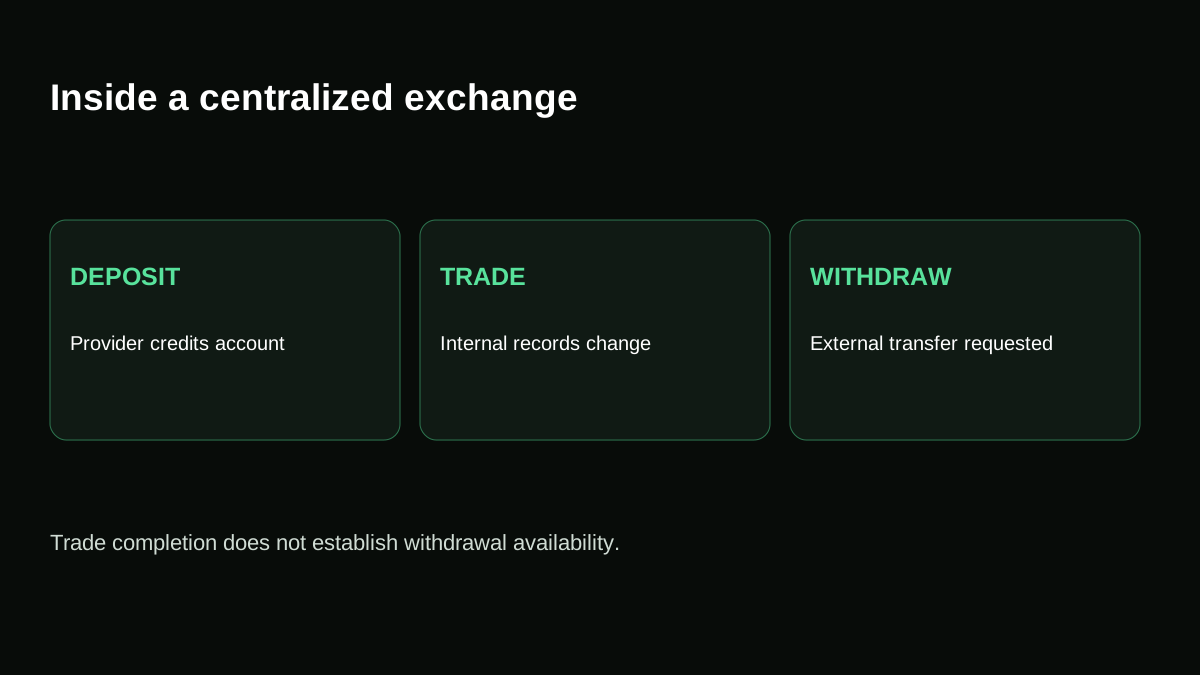
A trade changes the exchange's records
On a conventional order-book exchange, buyers and sellers submit instructions. The matching engine pairs compatible orders, and the service updates customer balances. Each matched trade does not normally require a separate public blockchain transaction.
A market order seeks execution against available orders. Its final price depends on depth and order size. A limit order specifies a price boundary but may not execute, or may fill only partly.
Buying BTC with a dollar balance therefore changes what the platform records as owed to you. It does not automatically move BTC into a wallet whose signing credentials you control.
For your first trade, identify the pair and the amount denomination. “Buy 50” could refer to dollars spent or units purchased depending on the screen. Read the order preview and completed execution record rather than inferring the result from the chart.
Withdrawal is a separate operation
Withdrawing crypto asks the provider to send assets to an external address using a supported network. Processing can include account checks, platform review, transaction batching and blockchain confirmation.
A successful trade does not prove that withdrawals are enabled. Check the relevant asset's status and any account restrictions before relying on an immediate transfer.
The withdrawal fee is also a service term. It may differ from the network fee ultimately paid by the platform. Minimums, holding periods and security-change delays can affect small balances or newly funded accounts.
When comparing exchanges, compare the complete intended journey: fund the account, buy the asset and withdraw through the required route. A low advertised trading commission can coexist with expensive funding or withdrawal costs.
What the account security settings protect
Strong login protection helps reduce unauthorized account access. Use unique credentials and supported multi-factor authentication, and investigate withdrawal-address controls and account alerts where available.
These controls do not eliminate provider risk or market losses. A protected login cannot force an insolvent or restricted business to process withdrawals. It also cannot stop a legitimate order you authorize from losing value.
Support access creates another attack surface. Reach help through verified official channels. Someone contacting you first and asking for a password, authentication code or remote access is not established as support by using the exchange's logo.
Keep a record of important account actions and transaction identifiers. If a problem arises, a precise description of the amount, asset, time and status is more useful than repeatedly retrying an unfamiliar action.
Evidence that deserves scrutiny
A provider may publish licenses, reserve information or security claims. Read what each actually establishes. A registration in one jurisdiction does not necessarily authorize every product everywhere.
A reserve snapshot can describe assets at a moment without fully establishing all liabilities, ownership rights or the ability to meet future withdrawals. Do not treat a proof-of-reserves page as interchangeable with a complete assessment of financial condition.
Likewise, a large reported trading volume does not guarantee deep liquidity for the pair and order size you need. Inspect accessible markets and actual execution conditions.
The question is not whether a platform can display reassuring evidence. It is whether the evidence answers the specific concern: custody, legal eligibility, execution, withdrawal or dispute handling.
A first-use checklist organized around your goal
Start with a sentence: “I want to spend this amount from this funding source, buy this asset, and hold or withdraw it this way.” That gives the comparison a clear endpoint.
Check eligibility and required verification before sending money. Then examine total costs and minimums. Finally, confirm the exit route and support process.
For a small test, ensure the amount is large enough to meet all relevant minimums. Test the final withdrawal where that is part of your plan, not only the account deposit.
Keep promotional rewards separate from the decision. A reward requiring substantial deposits or trading may not suit a beginner whose actual goal is a small first purchase.
Frequently asked questions
Is a CEX account the same as a personal wallet?
No. An exchange usually controls the underlying signing arrangements. A conventional self-custody wallet gives you control of the credentials needed to authorize spending. Each arrangement has different recovery and operational responsibilities.
Does identity verification mean an exchange is safe?
Verification can help meet account and compliance requirements. It does not establish the provider's financial condition, eliminate fraud risk or guarantee that every listed asset is suitable for you.
Can I trade while crypto withdrawals are paused?
Some services may allow internal trading during a withdrawal pause. Check the exact status. An active market does not prove that assets can currently leave the platform.
Are all exchange products spot trading?
No. The same platform can offer derivatives, lending, staking or other products with different risks and terms. Confirm which product you are using before relying on a simple buy-and-hold explanation.
Sources and boundaries
Checked November 19, 2026: Coinbase trading rules and the SEC custody bulletin. Provider documents describe particular services, not universal terms; the trading-rules page can redirect to a regional version. This article does not rank or certify an exchange. Compare the operating model with a DEX.