An altcoin is usually any cryptocurrency other than Bitcoin. Some people use the word more narrowly, excluding other established assets. It is a market label, not a technical standard, quality rating or promise that a smaller asset will outperform BTC.
That broad definition places very different things together: native blockchain coins, stablecoins, governance tokens and speculative projects. Before judging an altcoin, identify what the particular asset actually does and what rights, if any, holding it provides.
Why “alternative to Bitcoin” became such a large category
Early alternatives explored changes to digital-currency design. The market later expanded into programmable networks and many kinds of tokens. The original label remained, even though a payment coin and a dollar-linked token may solve entirely different problems.
This makes a simple “Bitcoin versus altcoins” comparison limited. Bitcoin's supply rules, network and transaction model do not describe every alternative. Nor can a success story from one project establish the prospects of another.
When reading commentary, check the author's definition. An “altcoin market” statistic may include or exclude stablecoins, ETH or small tokens. Two charts using the same phrase can measure different groups.
The first improvement in your research is therefore modest: replace “Is this altcoin good?” with “What kind of asset is this, and what would have to be true for it to serve its stated purpose?”
Sort the asset by function before comparing it
An asset's function suggests what evidence to examine. A native coin needs a network-use and security explanation. A stablecoin needs a peg and redemption explanation. A governance token needs a clear account of the decisions holders can actually influence.
| Category | Start by investigating |
|---|---|
| Native network coin | Network demand, issuance, validator or miner incentives |
| Application token | Actual token utility, contract permissions, dependence on the app |
| Stablecoin | Reference asset, backing mechanism, redemption and liquidity |
| Governance token | Voting scope, participation, delegation and administrative powers |
| Memecoin | Market structure, concentration and speculative demand |
Categories can overlap. A project may describe a token as “utility” while most demand comes from speculation. Evaluate what users can currently do, not just what the roadmap imagines.
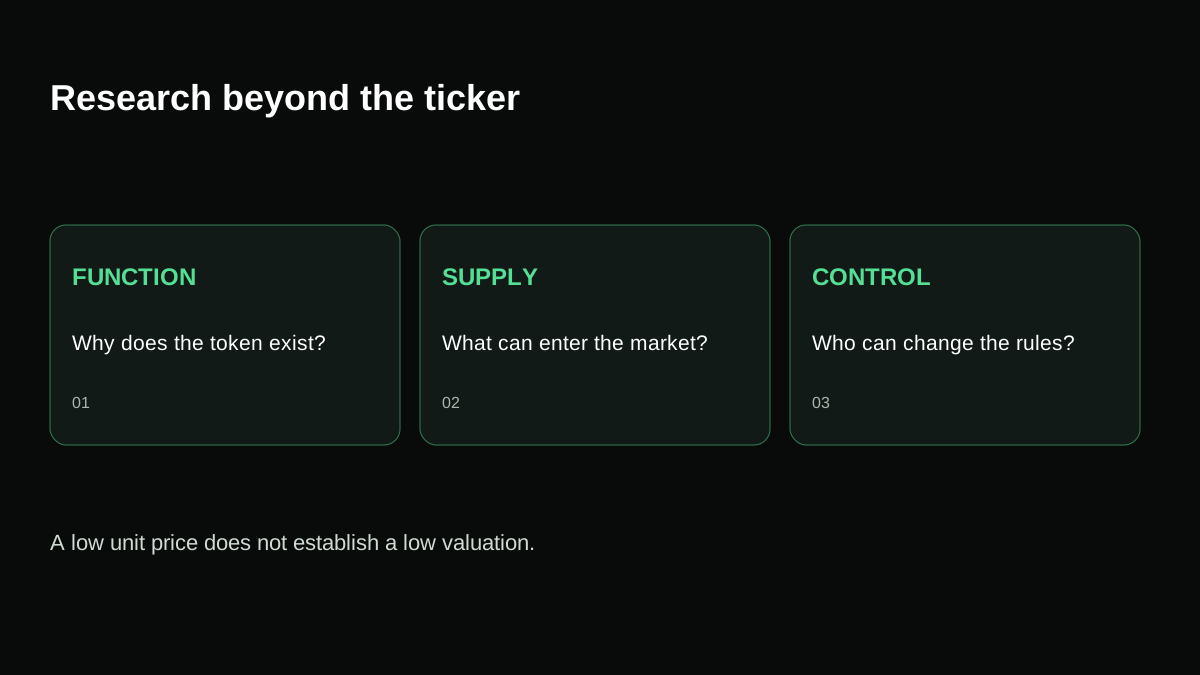
A low unit price does not establish a bargain
A token trading for a tiny fraction of a dollar may have an enormous supply. The number of units is chosen through the asset's design; it does not reveal how inexpensive the whole project is relative to its prospects.
For a hypothetical illustration, 100 billion circulating tokens at $0.01 imply a $1 billion circulating market capitalization. A $1 token with one million circulating units implies $1 million. These numbers do not establish fair value, but they show why unit price alone is inadequate.
Also examine future issuance and unlocks. Circulating supply can differ from total or maximum supply, and the definitions used by data providers may vary. A small circulating float can create a misleading impression if substantial supply can enter the market later.
Avoid the phrase “it only needs to reach one dollar” until you calculate the implied capitalization at the relevant supply. A memorable price target does not create the demand needed to support it.
Ownership concentration changes the question
If a small group can sell a large share of available tokens, the market can be sensitive to its actions. Wallet-distribution information can help, but it requires interpretation: one exchange address may represent many customers, while one owner may control many addresses.
Look for documented allocations, vesting schedules and treasury policies alongside on-chain holdings. Ask whether insiders can transfer or unlock tokens and what restrictions actually exist.
Administrative control matters too. Depending on the contract, privileged roles may mint tokens, pause activity, change fees or upgrade logic. A project calling itself decentralized does not answer whether these powers exist or who holds them.
Your conclusion should identify the uncertainty. “The largest address is an exchange according to its public label” is different from “ownership is evenly distributed.” Do not turn an uncertain label into a strong decentralization claim.
Liquidity determines what a displayed price is worth to you
A token's last trade can look attractive while the market has little depth. A buyer may find that a meaningful order pushes the price sharply upward; a seller may find few bids near the quoted level.
Check the market available on the venue you can actually use. Reported global volume is not the same as accessible liquidity, and volume can be misleading if trading is artificial or concentrated on unreliable venues.
For a proposed purchase, compare the expected execution, all charges and the exit route. If the plan relies on selling quickly, ask how that would work during a demand shock rather than assuming today's quote will remain available.
This matters particularly for new listings. A dramatic percentage rise can describe a thin market and a small starting base rather than broad, sustainable demand.
A five-question note is better than a collection of slogans
Before researching price predictions, write short answers to five questions: what does the asset do, why does that require this token, how can supply change, who has special powers, and where can you exit?
Add a source to each answer. Official documentation can establish the project's stated design; code and on-chain data can help check implementation. Neither proves a future business outcome.
If an answer is missing, keep it missing. Do not replace absent evidence with a large follower count, influencer enthusiasm or an exchange listing. Those signals can help explain attention, but they do not settle the underlying questions.
You can learn the categories without buying a token. Start with coin versus token, then compare two projects serving the same purpose rather than unrelated assets sharing the altcoin label.
FAQ
Is ETH an altcoin?
Under the broad “anything other than Bitcoin” definition, yes. Some writers separate ETH when discussing market segments. Check the definition used rather than treating the terminology dispute as an investment conclusion.
Does every altcoin have its own blockchain?
No. Some are native coins; many are tokens issued using another network. The host chain can provide infrastructure without endorsing the token or guaranteeing its economics.
Does a token burn guarantee a price increase?
No. A reduction in supply can occur alongside falling demand, additional issuance or weak liquidity. Assess the scale and mechanism of the burn within the complete supply picture.
Is buying several altcoins enough diversification?
Not necessarily. Assets can share dependence on the same market cycle, network, platform or investor sentiment. Count underlying exposures rather than assuming ten tickers create ten independent sources of risk.
References
Terminology and mechanisms checked November 19, 2026: Ethereum technical introduction, ERC-20 specification overview, Bitcoin FAQ, and Ethereum stablecoins. “Altcoin” is informal market usage; the evaluation framework and numerical example above are original explanatory tools, not a ranking or valuation.