A stablecoin is a crypto asset designed to track a reference value, often one US dollar. Its market price can still depart from that target. To understand the risk, examine how the target is supported, who can redeem the token and what you would actually receive when selling.
The word “stable” is easy to overread. It describes the intended relationship to a reference asset, not guaranteed access to cash, permanent purchasing power or protection against every loss.
Three numbers that should not be confused
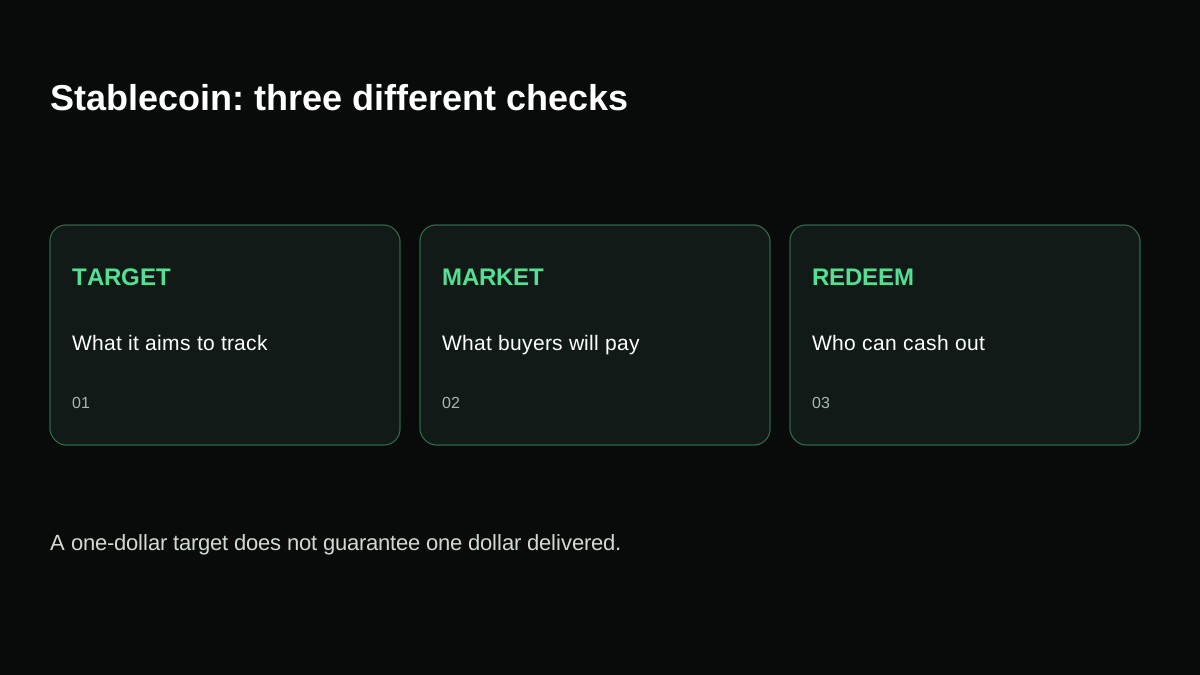
A stablecoin has a target value, a market price and a redemption arrangement. These can be related without being identical. The target may be $1, the exchange quote may differ, and direct redemption may be available only to eligible customers under issuer terms.
When you sell through an exchange, you transact at that venue's available price. You are not necessarily redeeming directly with the issuer. Fees, spread and the subsequent cash withdrawal can reduce the amount reaching your bank.
An issuer's published reserve information addresses another question: what assets are reported as supporting its liabilities? That information helps evaluate backing, but does not itself complete your redemption or prove the exchange holding your balance can process a withdrawal.
How different designs try to maintain their value
Stablecoins use different mechanisms. Some issuers hold conventional financial assets; some systems use crypto collateral; others rely more heavily on trading incentives and supply adjustments. The details determine how a design might behave under stress.
Reserve-backed models depend on the issuer's assets, custody, liabilities and redemption arrangements. Read what the reserve report actually covers and its reporting date. “Backed” is the beginning of an investigation, not its conclusion.
Crypto-collateralized models depend on collateral values and rules for managing shortfalls. Overcollateralization can provide a buffer, but falling collateral prices, liquidation problems and software failures can still matter.
Algorithmic or incentive-heavy models may depend on demand for a related asset or arbitrage mechanism. A stabilizing trade can stop working when confidence disappears or market capacity is insufficient. Do not apply one issuer's reserve explanation to a different design.
These are broad categories. A particular product can combine elements, change its arrangements or rely on additional intermediaries. Identify the actual mechanism before comparing risks.
Why a peg can break
A depeg means the market price has moved away from the intended reference. It can reflect doubts about backing, restricted redemption, stressed liquidity or a problem affecting the venues used to trade the asset. Different causes call for different evidence.
One exchange showing an unusual quote does not prove every market has the same price. Check the exact trading pair, order-book depth, timestamp and whether deposits or withdrawals are restricted.
Conversely, a normal quote on a thin market does not guarantee that a large balance could be sold at that level. The executable price for your order size is more informative than a single displayed last trade.
For someone holding a stablecoin, the practical question is: can I exchange my actual token, on my actual network, through an available route, at an acceptable total cost? A general statement about the peg cannot answer every part.
A dollar stablecoin still moves against your home currency
Stability is relative to the reference. If a token tracks USD, its value in euros, pounds or Vietnamese dong changes with the relevant exchange rate. It also does not remove changes in what a dollar can buy.
Consider a hypothetical holder who buys a dollar-linked token using local currency and later sells when its dollar price is unchanged. The local-currency result can still differ because the exchange rate moved. Platform costs can change the result again.
This is why stablecoins should not be described as “no-volatility crypto” without qualification. They target a particular unit, and users can experience a different unit of risk. Decide which currency your future expenses are in before treating the balance as stable for your needs.
Holding a stablecoin is different from lending it
You may see interest, rewards or an annual yield displayed next to a stablecoin balance. The return usually involves an additional product or arrangement. The stablecoin's price target does not explain where that return comes from.
Ask whether the asset is being lent, deposited into a contract, placed with a custodian or exchanged for a receipt token. Investigate withdrawal conditions and who bears losses if the arrangement fails.
A yield offer can create several simultaneous dependencies: stablecoin issuer, blockchain, application, collateral and service provider. A reassuring reserve report for one layer does not establish the safety of the entire chain.
Separate the decision to hold a stablecoin from the decision to earn a return on it. Compare the additional risks with the actual purpose of the money, especially if it is needed for near-term expenses.
What to check before a first transfer
Identify the issuer, exact token and supported network at both ends. A token can exist on several networks, and a bridged representation can have a different risk structure from an issuer's native issuance.
Then check how you will pay transaction fees. Depending on the network and wallet arrangement, you may need its native asset even though the balance you intend to send is a stablecoin.
Finally, confirm the exit route. A provider supporting stablecoin deposits may not offer a bank withdrawal method available to you. Assess the complete journey before sending funds, not after discovering the last step is unavailable.
For a direct issuer comparison, read USDT and USDC explained. It treats the ticker as only the start of the decision.
FAQ
Is a stablecoin a bank deposit?
Do not assume so. Token ownership, issuer redemption and bank-deposit relationships have different terms and protections. Check the specific product and jurisdiction instead of treating a dollar symbol as proof of deposit insurance.
Can a stablecoin be frozen?
Some issuer-controlled tokens have administrative mechanisms that can restrict transfers involving particular addresses. Capabilities differ. Read the specific issuer's terms and contract information rather than assuming all tokens are equally censorship-resistant.
Does a reserve attestation prove every possible risk is covered?
No. Read its scope, date and assurance wording. A report about specified reserve information is not automatically a full financial-statement audit, a prediction of future liquidity or a guarantee of your exchange balance.
Is every coin worth about one dollar a stablecoin?
No. A coincidental market price is not a stabilization mechanism. Establish whether the project actually targets a reference and how it proposes to maintain that relationship.
Sources and scope
Checked November 19, 2026: Ethereum stablecoin explanation, Circle transparency, Circle USDC terms, Tether transparency and Tether legal terms. No current reserve amount or market price is asserted. The exit-route questions are an editorial decision framework, not a recommendation to use a particular issuer.