USDT and USDC are stablecoins designed to track the US dollar. USDT is issued by Tether; USDC is issued by Circle entities under applicable terms. Both can be traded or transferred through supported services, but their issuers, redemption arrangements and available networks differ.
Neither is simply “dollars in your wallet.” To use one safely, identify the exact token, network and route into or out of ordinary money. The right comparison depends on the task you need to complete.
Start with the transfer, not a universal winner
If your purpose is to pay someone, their supported receiving arrangement comes first. A preference for one stablecoin is irrelevant if the recipient cannot accept it on your selected network.
If your purpose is to hold a dollar-linked balance, issuer arrangements and custody deserve more attention. If you plan to trade, examine the executable prices and costs for the pair and order size you actually use.
These tasks can lead to different choices. A claim that one token is always cheaper or safer skips important details about the platform, network, jurisdiction and route involved.
The comparison that matters
| Question | USDT | USDC |
|---|---|---|
| Who publishes issuer information? | Tether | Circle |
| What reference is targeted? | US dollar | US dollar |
| Where should backing claims be checked? | Tether's current transparency reports | Circle's current transparency reports |
| Can every holder redeem directly? | Eligibility and current terms apply | Eligibility and current terms apply |
| Is every network supported everywhere? | No; check the receiving service | No; check the receiving service |
The table deliberately avoids reserve percentages, redemption minimums and network counts. These are changeable details that should be read from the live issuer documentation when making a decision. A stale comparison can create false precision.
The useful distinction is between what the issuer promises under its terms and what a third-party exchange offers to a customer. Those are separate relationships, even when the same ticker appears in both.
Reserve reports need careful reading
Tether and Circle publish information about assets supporting their stablecoins. The relevant questions include the report date, categories of assets, liabilities covered and the assurance work described. A large headline reserve number alone does not answer all of them.
Use the issuer's own report as a primary statement, while recognizing its scope. Avoid treating an attestation about specified information as an unrestricted guarantee about future solvency or uninterrupted redemption.
Also avoid importing backing claims from a different product. A bridged token using a familiar name may depend on an intermediary mechanism rather than being identical to the issuer's native token on that network.
For readers, a repeatable method is more useful than a fixed verdict: open the current report, record its date, identify what is covered, and compare those facts with the terms applying to your route.
Buying on an exchange is not direct redemption
Most retail users encounter USDT or USDC through a trading platform. Buying or selling there uses that venue's pricing and liquidity. It does not automatically establish a direct account with the issuer or a right to use its institutional redemption process.
Before relying on a stablecoin for an upcoming expense, verify the actual cash-out path available to you. Check sale availability, bank payout methods, account verification, charges and possible restrictions.
A hypothetical example makes the distinction clear. If a platform sells your tokens for $100 but deducts a $2 payout charge, the bank receives $98. The token maintaining its target does not remove that service cost.
This example is not a fee quote for either issuer or any platform. Its purpose is to show why “one token equals one dollar” and “one dollar reaches my account” are different statements.
Why the network selection is critical
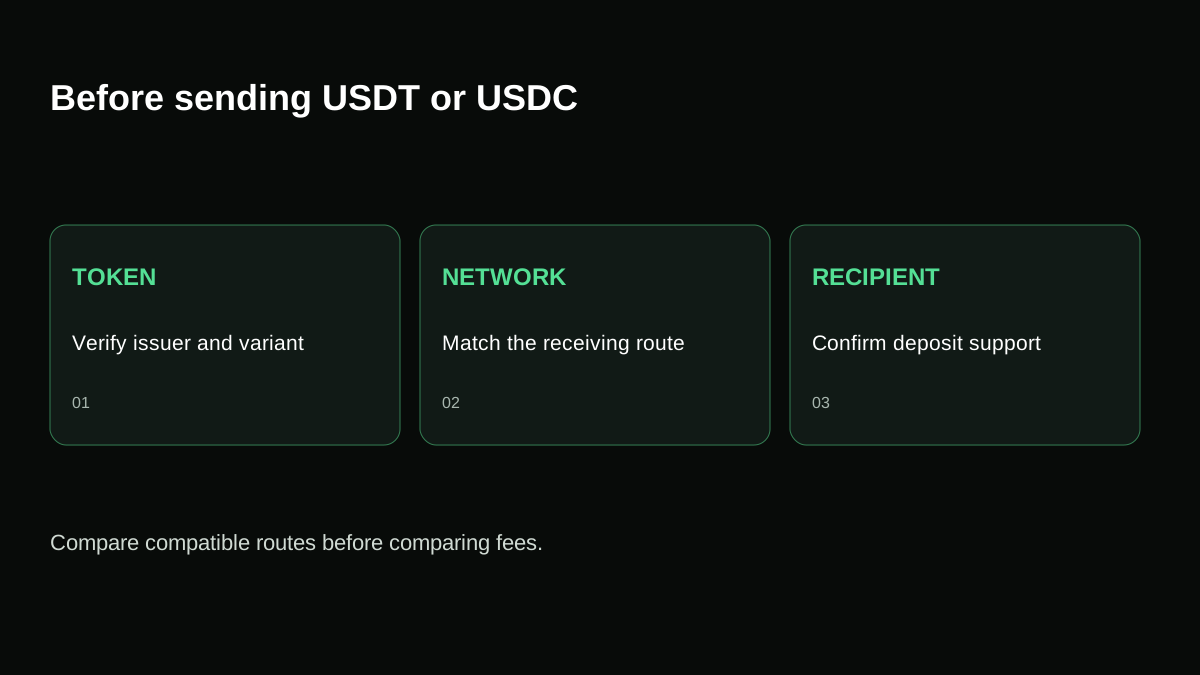
USDT and USDC can be available across multiple blockchain environments. Each transfer takes place on a particular network. Both the sending and receiving services must support the exact route, including any relevant token variant.
Do not choose a network from the sending dropdown solely because it has a lower withdrawal fee. First find the recipient's deposit instructions. The cheaper option may be unsupported and create a difficult or impossible recovery problem.
When using a self-custody wallet, check transaction-fee requirements too. The stablecoin balance itself may not pay the network fee. A service offering sponsored transactions is a separate arrangement, not a property you should assume everywhere.
For a new route, a small test can limit the amount initially exposed, but it still must meet deposit minimums. Confirm actual recipient credit before sending the remainder. Recheck saved details whenever the receiving service changes its instructions.
Four claims that need qualification
“USDT is accepted everywhere” confuses broad availability with universal support. Check your specific platform and network.
“USDC is the same as a bank account” confuses a dollar-linked token with a deposit relationship. Read the applicable terms and protections.
“The stablecoin transfer is free” may omit withdrawal charges, gas, conversion spread or the last step into local currency.
“A token bearing the correct symbol is authentic” ignores how easily names and symbols can be copied. Verify the token identifier through the issuer's official resources and the relevant network.
These qualifications are not reasons to memorize endless technical details. They identify the small set of facts that determine whether your intended transfer will work.
FAQ
Can I send USDT to a USDC deposit address?
Do not treat the assets as interchangeable. A service may assign the same-looking address to multiple assets, but supported deposits are governed by its instructions. Confirm the exact asset and network before sending.
Does USDT or USDC pay interest automatically?
Holding the token does not by itself establish a right to an advertised yield product. Rewards or interest usually involve additional platform terms, lending, contracts or another arrangement that must be evaluated separately.
Can I swap between them without costs?
Not necessarily. A trade can involve spread, trading fees, slippage and network costs. Even where a platform advertises no commission, compare the final amount delivered for your actual order size.
Which is best for a beginner?
Choose only after defining the task and checking eligibility, recipient support, total costs and issuer risks. A universal ranking would conceal the practical constraints that matter most to a first transfer.
Sources
Checked November 19, 2026: Tether transparency, Tether legal terms, Circle transparency and USDC terms. These are issuer disclosures, not independent promises from this publication. See also what a stablecoin is.