A memecoin is a crypto asset associated with an internet joke, character, cultural moment or online community. Its trading demand often depends heavily on attention and speculation. The label does not establish useful rights, reliable liquidity or protection against insiders and scams.
The entertaining part is easy to understand. The harder part is recognizing that a familiar image can sit on top of a market with concentrated ownership, opaque promotion and very little available exit liquidity.
What you own when you buy the meme
You own the particular coin or token described by its network and rules. You do not automatically own the image's intellectual property, membership in a profitable business or a claim to future revenue.
Some memecoins are native coins; others are contracts on existing networks. A copied name and symbol can refer to a completely different asset. Identify the exact token before assuming you are looking at the project everyone is discussing.
Community activity can be real without creating enforceable economic rights. A lively chat group may organize events and produce artwork while the token remains highly speculative. Assess those cultural activities separately from promises about returns.
That separation prevents a common mistake: treating enthusiasm as a substitute for knowing the asset's supply, controls and trading conditions.
How attention becomes price movement
Memecoin prices can respond to social posts, celebrity associations and rapidly changing narratives. When buyers compete for limited available supply, price can rise sharply. When attention fades or large holders sell, the same market can reverse quickly.
The sequence creates a strong emotional pull. A newcomer sees screenshots of earlier buyers' gains and imagines repeating them. Those screenshots usually say little about unsuccessful trades, fees, liquidity or whether the advertised profit was ever realized.
Watch the difference between visibility and demand. A trending phrase can be generated by paid promotion, repeated posts or coordinated accounts. Even genuine attention does not tell you how long buyers will remain willing to pay.
For research, document the claim you are relying on. “People are talking about it” is an observation about attention. “The token has durable demand” requires much more evidence.
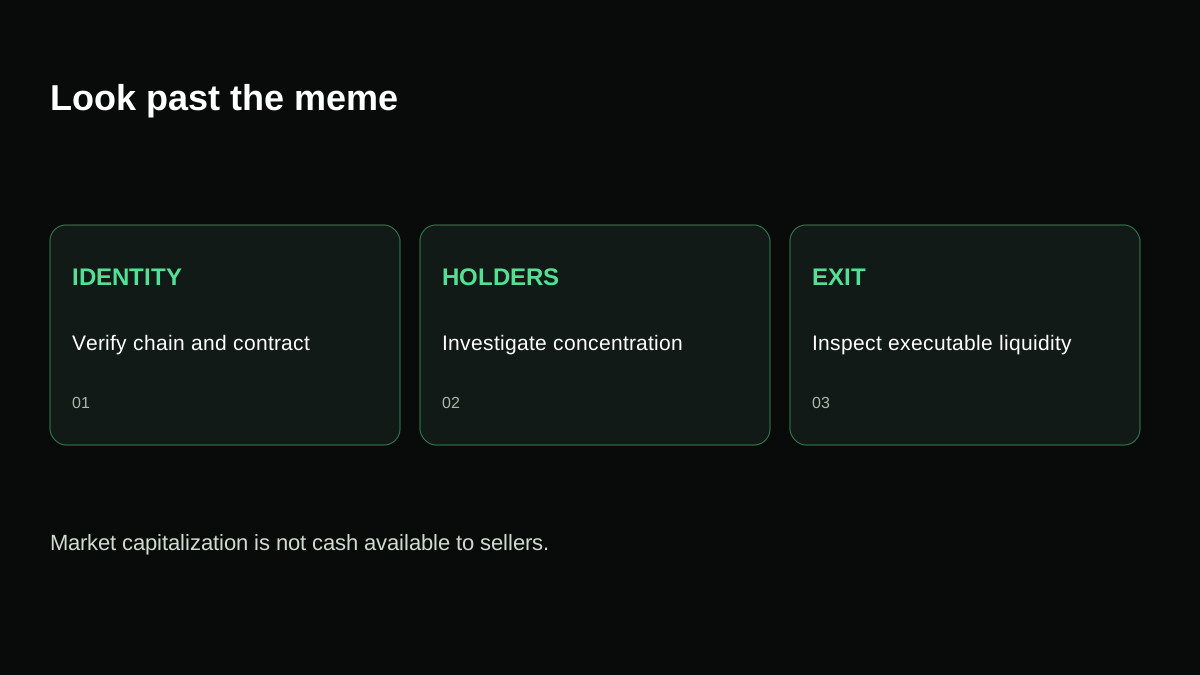
Why market capitalization is not cash waiting for sellers
Market capitalization is commonly calculated from a price multiplied by a supply figure. It is not the amount of money sitting in a pool ready to purchase everyone's holdings. Thin trading can produce a headline valuation that cannot be realized by large sellers.
Imagine a hypothetical token with one billion circulating units and a last trade of $0.01. Its calculated capitalization is $10 million. That calculation does not mean $10 million has been invested or could be withdrawn without affecting the price.
Inspect the actual market depth or pool liquidity. Also ask whether trading is concentrated on one venue and whether customers in your region can access it. A global volume figure can be irrelevant to your own exit route.
This is why unrealized gains deserve caution. A wallet can display a value based on an external quote while selling the whole balance would deliver much less—or fail entirely.
The contract and distribution can matter more than the artwork
Look for powers to create additional supply, restrict transfers, change transaction charges or upgrade the contract. A technical reviewer can help interpret the code, but no single automated score should be treated as a clean bill of health.
Distribution requires context as well. Large addresses may be exchange custody, liquidity contracts or insiders. Public labels can be incomplete. Investigate allocations and transfer patterns before confidently identifying who controls the supply.
A claim that liquidity is “locked” answers only a narrow question. You need to know which position is locked, for how long, under what conditions and whether other positions or administrative powers remain available.
Avoid turning a checklist into a guarantee. Passing several checks can reduce specific uncertainties while leaving market risk, unknown relationships and undiscovered vulnerabilities intact.
Promotion can create conflicts you cannot see
An influencer may own tokens, receive payment or have an incentive tied to referrals. A promotional post might omit these facts. A large following is evidence of reach, not independent analysis.
Look for clear disclosures and verifiable claims. If a post promises an imminent exchange listing, find the exchange's own announcement. If it claims a partnership, seek confirmation from the named partner rather than a screenshot inside a community channel.
Pressure language is itself useful information. “Buy before the announcement” asks you to act before verification. “Only sellers lose” tries to replace a financial decision with group loyalty.
You do not owe a token community continued financial exposure. Decide in advance how much you can lose and whether you understand the market well enough to participate at all.
What the US regulatory discussion does—and does not—mean
In February 2025, SEC staff published a statement discussing certain described meme-coin arrangements. The statement explicitly described its limited status and facts-based scope. It should not be read as worldwide approval or an assurance that every token marketed as a memecoin is outside securities laws.
Legal labels and financial safety are separate issues. A product can present serious fraud or loss risks regardless of which particular regulatory regime applies. Your country may apply different rules to promotion, trading or tax.
For the original wording and limitations, consult the SEC staff statement. Avoid summaries that convert a narrow staff view into “memecoins are legal and safe.”
FAQ
Is every memecoin a scam?
No. A speculative cultural asset is not automatically fraudulent. Fraud depends on conduct and representations. However, an honest description of speculation does not remove the possibility of losing the entire amount spent.
Does an established blockchain make a memecoin safe?
The chain can validate transactions without evaluating token economics, promoter honesty or your ability to sell. Separate network security from the asset and market operating on top of it.
Can a successful test sale prove I can exit later?
It can show that a particular sale worked at that time and size. It does not guarantee future liquidity or unchanged contract behavior. Treat it as limited evidence rather than a lasting assurance.
Why can two tokens use the same name?
Names and tickers are not universally unique identifiers. Different contracts can copy them. Verify the chain and contract through reliable project sources and inspect the exact market before transacting.
Sources
Checked November 19, 2026: the SEC statement, Ethereum token standards and Ethereum security guidance. The hypothetical capitalization example explains arithmetic only. For the wider category, read what an altcoin is.