Staking means committing crypto to participate in a proof-of-stake network's security, directly or through a supported arrangement. Rewards depend on network rules and participation. Products marketed as staking can add custody, contracts or receipt tokens, so their risks go beyond the underlying protocol.
An advertised annual percentage is only one part of the decision. You also need to know what you deposit, who controls it, how rewards are calculated and how you get back to assets you can use.
Protocol staking and a retail product are different layers
At the protocol level, validators perform duties under network rules. Economic commitments and penalties support honest participation. The precise role, requirements and withdrawal mechanics differ by chain.
A retail service may operate validators for you, pool assets from multiple users or issue a token representing participation. An exchange may record a staking balance within a custodial account.
These arrangements can simplify access, but they change the dependency chain. Your outcome can depend on a provider, contract or market as well as the validator's performance.
Before comparing yields, name the arrangement accurately. “Staking ETH through an exchange” and “running a validator under your own control” are not the same activity with different buttons.
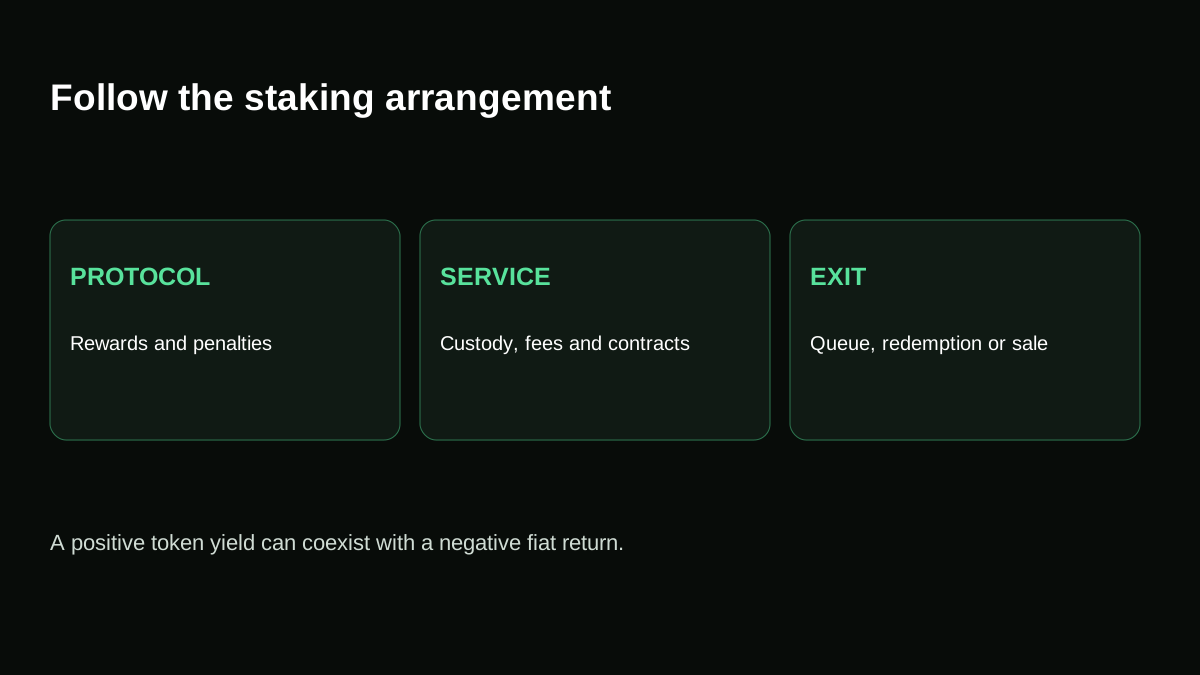
Where the reward comes from
Protocol rewards can reflect issuance and other network-specific mechanisms. A service may deduct commission or operating fees before crediting the user. Additional promotional rewards may have separate funding and conditions.
Read whether the displayed rate is gross or net, historical or estimated, and variable or contractually defined. A changing network rate should not be represented as a fixed guaranteed return.
APR and APY also answer different questions. APY incorporates a compounding assumption; receiving rewards does not prove they will automatically be reinvested on the advertised schedule.
For a fair comparison, use the same period, fee treatment and reinvestment assumptions. Two percentages are not comparable if one excludes charges and the other assumes continuous compounding.
More tokens can still mean less money
Staking rewards are commonly denominated in the asset or a related token. Its market price can fall while the number of units you hold rises.
Suppose a hypothetical holding of 100 tokens earns five additional tokens over a year. If the token's price falls from $10 to $6, the final 105 tokens are worth $630 rather than the initial $1,000, before other costs.
The numbers are deliberately hypothetical. The point is that a positive token yield and a negative fiat result can happen together. Rewards do not insure the principal against price movements.
Also consider supply changes. If many holders receive issuance, your unit balance can grow without an equivalent increase in your share of the network's economic value.
Withdrawal is part of the product
Some arrangements involve waiting periods, queues or provider processing. A service advertising instant access may be offering a separate liquidity facility or a market sale rather than immediate protocol withdrawal.
If you receive a liquid staking token, selling it can be different from redeeming through the underlying process. Market price, available depth and fees affect the sale route.
Ask what happens under stress. Can the provider delay processing? Is redemption dependent on a queue? Could the receipt token trade below the value implied by the underlying claim?
These questions matter before committing funds needed for a known expense. A high estimated yield is not useful if the exit route does not match your time horizon.
Penalties and operational risks vary
Proof-of-stake systems can impose penalties for poor operation or specified misconduct. “Slashing” usually refers to particular punishable behavior, not every reduction in rewards, and details differ by protocol.
Provider guarantees should be read under their terms. A promise to reimburse certain penalties may exclude contract failures, market losses or other events.
Pooled contracts add software and administrative risk. Exchange products add custody and account restrictions. Running your own infrastructure introduces operational responsibilities.
No arrangement removes all risk. Choose based on which responsibilities you understand and which dependencies you are willing to accept, rather than treating the highest rate as the complete answer.
Compare the same journey
Write down the asset deposited, any asset received, reward source, deductions, loss scenarios and exit route. Then follow the money back to the form you actually need.
For example, returning to a bank balance can require unstaking or selling a receipt token, trading into fiat and withdrawing through a provider. Each step may introduce costs or restrictions.
Check whether the platform's “earn” product is actually protocol staking. Lending and promotional yield can be presented nearby while relying on different sources of return.
Keep screenshots or records of the terms at the time you commit. A clear record helps distinguish a variable reward rate from a material change to access or fees.
FAQ
Can every cryptocurrency be staked?
No. Native protocol staking depends on the network's design. A product offering a return on a non-stakeable asset uses some other arrangement, which should be explained rather than assumed to be proof-of-stake participation.
Is staking the same as mining?
No. They participate in different consensus designs. Proof-of-work mining relies on computational work, while proof-of-stake systems use validator participation and economic commitments under their rules.
Does self-custody remove staking risk?
It can change custody exposure, but protocol penalties, contract dependencies, withdrawal conditions and asset-price risk may remain. Identify which powers and risks your particular setup retains.
Should I compound every reward immediately?
Not automatically. Consider fees, minimums, additional permissions and how reinvestment affects access. An advertised compounding benefit can be outweighed by costs for a small balance.
Sources
Checked November 19, 2026: Ethereum staking, proof-of-stake documentation, staking withdrawals and security guidance. Ethereum examples are not universal rules for every chain. No current reward rate or product recommendation is asserted.