A seed phrase is a set of words used by many wallets to recover the cryptographic information controlling accounts. Anyone with the complete required recovery material may be able to recreate those accounts and spend their assets. Treat it as control over funds, not as an ordinary password hint.
Some wallets use other recovery designs. Before writing anything down, establish which method your wallet actually uses and what information a complete recovery requires.
Why a wallet gives you words
Recovery words provide a human-recordable representation used in a wallet's derivation process. BIP-39 is a widely used specification, but not every wallet follows it or uses an identical account-discovery process.
Common BIP-39 phrases contain 12 or 24 words, with other supported lengths also defined. The words and their order matter. They are generated from underlying randomness with a checksum, not selected as a memorable sentence.
Do not compose your own phrase or copy a sample from an article. A publicly displayed phrase is unsuitable for securing funds because other people already know it.
No example recovery phrase appears here. You can understand the mechanism without placing a realistic-looking secret into your notes or confusing tutorial words with a wallet you should fund.
What the phrase may restore—and what it may not
A phrase can help derive multiple keys and accounts within supported wallet designs. It is not necessarily a universal backup of every account ever displayed by the app.
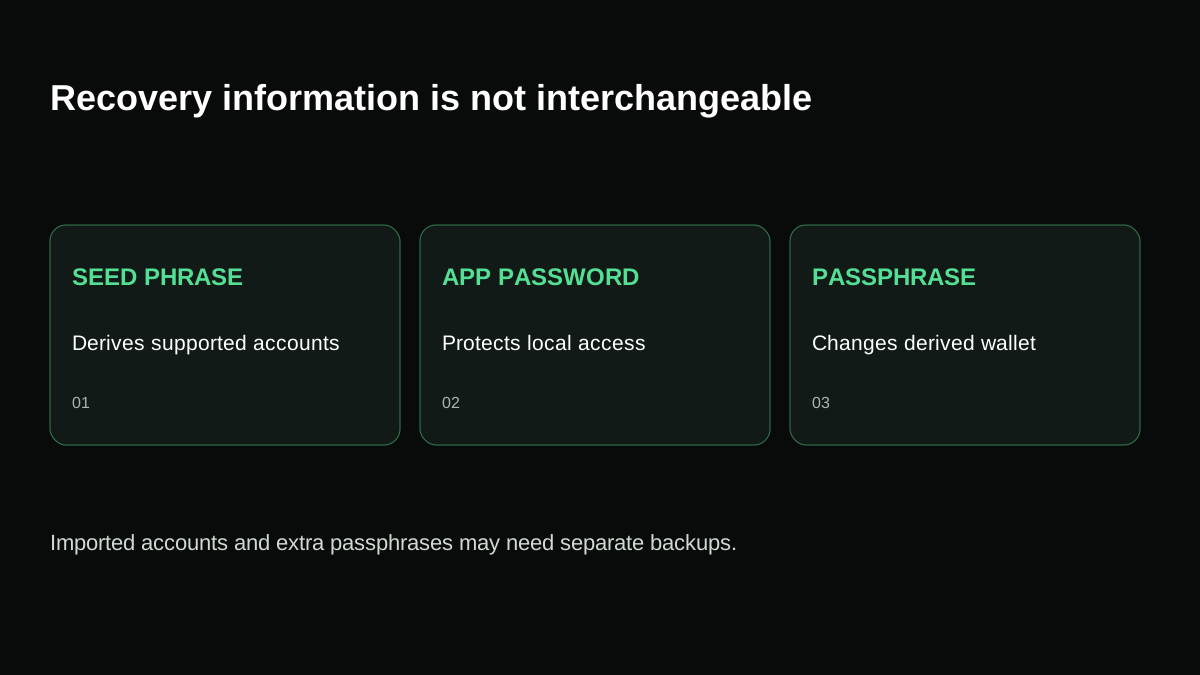
An account imported separately through a private key may need a separate backup. Hardware-linked accounts can have their own recovery roots. A wallet using an additional passphrase can require that exact passphrase too.
You may also need to identify the original network, account type or derivation method to locate the expected addresses. Seeing an empty account after restoration does not automatically prove the phrase was wrong or funds disappeared.
Record non-secret setup information alongside your recovery plan: wallet type, relevant networks and whether additional accounts or passphrases exist. Keep secret material appropriately protected, rather than placing everything in an easy-to-find inventory.
Seed phrase, app password and optional passphrase
These terms are easy to mix up. The seed phrase supports recovery. An app password often unlocks or decrypts local wallet data. An optional BIP-39 passphrase changes the seed derived from the mnemonic and must be reproduced exactly when used.
Calling an optional passphrase a “25th word” can be misleading because it need not be a single dictionary word. A different passphrase can produce a different wallet, including one that appears valid but empty.
That feature can improve a carefully planned setup, but it can also create unrecoverable mistakes. Do not add it simply because a forum says every advanced user should. Understand the wallet's verified procedure first.
Changing a local app password does not rotate a leaked seed phrase. Someone who can restore the wallet elsewhere may remain able to spend without knowing the new password.
Create the backup when the wallet creates the phrase
Use a verified wallet and follow its setup instructions. Ensure the environment is private and free from screen sharing or untrusted observers. A hardware device should not arrive with recovery words already written by a seller.
Write down the words accurately and in order using the supported process. Use the wallet's own verification feature where available. Do not enter the phrase into a website claiming to check its strength or synchronize your funds.
Keep digital capture out of the process unless your specific recovery design intentionally and securely requires it. Photos, clipboard history and cloud notes can create additional copies that are difficult to track or delete reliably.
The backup needs both secrecy and durability. Paper, metal and location choices have different tradeoffs. A fire-resistant object left in an obvious drawer still presents a theft risk.
Test recovery without teaching yourself an unsafe habit
The goal is to confirm your recovery method before it becomes your only remaining option. Use official backup-checking features where provided, and follow the wallet maker's instructions for any recovery rehearsal.
Do not wipe your only functioning device merely to test an unverified backup. Do not import a reserve wallet's phrase into random online software for convenience. That can change the exposure of the entire wallet.
If you practice with an empty learning wallet, keep its credentials separate from your real holdings. A successful rehearsal teaches the sequence; it does not prove a different backup has been recorded correctly.
Also plan for another person needing instructions after your incapacity. They should be able to find the recovery procedure through an appropriate inheritance arrangement without making the secret readily accessible during everyday life.
If the phrase may have leaked
Assume someone else may have control. Deleting a message, changing a password or revoking one token approval does not make a copied recovery phrase secret again.
Establish new credentials in a clean environment using verified tools. Moving assets can be urgent, but careless actions can expose more funds, particularly where an attacker operates automated sweeping software.
Do not accept a recovery offer from someone who contacts you first. A helper asking for the phrase increases the number of people with access. Public transaction information is enough to begin investigating on-chain activity.
If you still have access and simply lost the written backup, the situation differs from a leak. Consult official guidance and secure a valid recovery arrangement while access remains. Do not wait until the device fails.
FAQ
Can customer support recover my seed phrase?
For a conventional self-custody wallet, support cannot normally reconstruct missing secret material from your name or email. Services with different recovery models must be evaluated under their actual terms and design.
Can I translate the words into another language?
Do not substitute translations. Recovery relies on the exact supported representation and order. Follow the wallet's documentation rather than assuming translated words are equivalent.
Should I divide the words into homemade pieces?
Improvised splitting can weaken security or make recovery fail. A purpose-designed secret-sharing scheme is different from casually dividing a phrase. Use only a supported method you understand and can reliably reconstruct.
If no money is missing, does that mean the phrase is safe?
No. An attacker may wait, monitor future deposits or have accessed only some accounts. Absence of visible theft is not proof that compromised recovery material remains secure.
Sources
Checked November 19, 2026: BIP-39 specification, Bitcoin wallet security, Ethereum security and Bitcoin wallet documentation. Recovery details vary; use the official instructions for your actual wallet. Related: private keys and public addresses.