A hot wallet uses signing credentials on an internet-connected system. Cold storage keeps signing secrets isolated from ordinary online exposure. Hardware wallets are a common way to achieve that isolation, but device type, account use and backup handling all affect the real security of the setup.
“Cold” does not mean coins are moved off the blockchain. It describes how access is protected. Your assets remain represented by network records regardless of whether the signing device sits in a drawer.
What online exposure changes
A software wallet on a connected phone or computer offers convenient access. The same device may also browse websites, install applications and handle messages. Malware or an unsafe backup process can therefore threaten the signing information.
A dedicated hardware signer is designed to authorize transactions without exposing its private keys to the connected computer. The computer may prepare the request while the device handles signing.
This reduces one important attack path: stealing the private key through ordinary compromise of the host machine. It does not establish that every request presented to the signer is safe or that the user will inspect it correctly.
Terminology differs between providers. Some reserve “cold wallet” for accounts kept separate from active contract use. Focus on the actual exposure and workflow instead of treating a label as a universal standard.
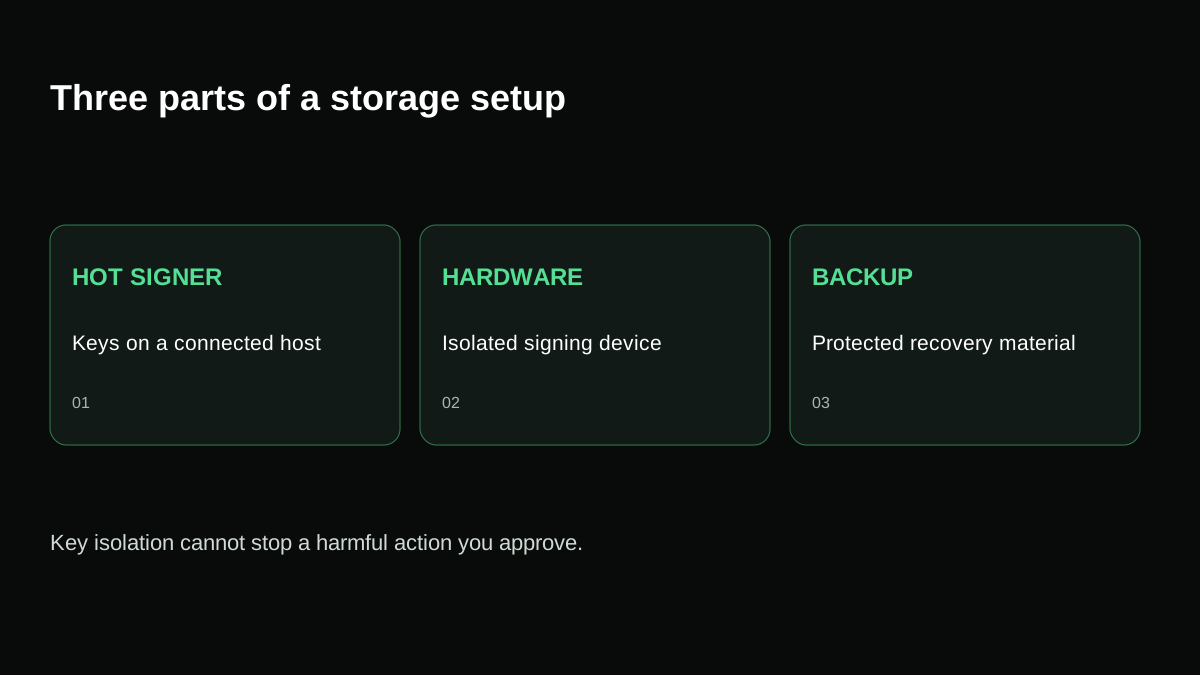
Compare the whole arrangement
| Dimension | Typical software hot wallet | Hardware-based storage arrangement |
|---|---|---|
| Signing location | Connected phone or computer | Dedicated device |
| Convenience | Quick access through an app | Additional confirmation steps |
| Key exposure | Depends heavily on host security | Designed to isolate keys from the host |
| Recovery | Backup method must be protected | Backup method must still be protected |
| Malicious authorization | Possible | Still possible if approved |
These are common patterns, not promises about every product. Quality, implementation and user behavior matter. A poorly handled hardware-wallet backup can undermine the benefit of key isolation.
The comparison should also include accessibility. If a recovery process is too complicated for you to perform reliably, theoretical strength can become a practical weakness. Choose a system you can operate and maintain.
A hardware wallet can sign a harmful instruction
Keeping keys isolated does not prevent you from authorizing an unwanted transaction. A malicious website can ask for a transfer or token permission, and the user can approve it through a legitimate device.
Read the information on the trusted device screen, where supported, rather than relying only on the computer's description. Check addresses and amounts, and understand any contract interaction before confirming it.
Blind or unclear signing deserves particular caution because the display may not provide enough information to evaluate the full effect. Do not assume a physical button press turns an unreadable request into a safe one.
For long-term storage, limiting unnecessary app interactions can reduce exposure. Use a separate activity wallet when experimenting, with only the amount needed for that purpose.
Offline keys need an offline recovery plan
The backup can be more important than the device. If someone obtains the recovery material needed to recreate your signing credentials, they may not need the hardware wallet or its PIN.
Protect the backup from both unauthorized access and physical loss. Paper can suffer fire or water damage; metal can improve durability but does not prevent theft. Where you keep it and who can discover it remain central questions.
Do not photograph recovery words as a convenience. A photo can spread through cloud synchronization, device backups or shared albums. An offline signer with an online recovery secret is not the arrangement you intended.
Additional passphrases can create another layer, but also another way to lose access. Learn the wallet's exact recovery requirements and record the method without making the secrets casually discoverable.
Separate by purpose rather than copying one seed everywhere
Using the same recovery phrase in several devices can undermine separation. If a phrase generated for isolated storage is imported into ordinary online software, the private-key protection model changes.
Creating multiple addresses from one recovery root can help organize activity, but it does not necessarily protect against compromise of that root. A genuinely separate wallet may require separate recovery credentials.
For everyday use, decide the amount you need for transactions and the permissions that activity requires. For reserves, decide how infrequently you need access and how recovery would work after device loss.
Avoid unnecessary complexity. Two understandable arrangements can be easier to maintain than many wallets with unclear backups and overlapping permissions. Document purposes and recovery locations without listing secrets in a shared inventory.
A decision based on consequences
Ask what a loss would mean to you. There is no universal dollar threshold at which everyone should buy a particular device. Personal circumstances, transaction frequency and confidence with backups matter.
If using a hot wallet, keep the host updated, obtain software through verified channels and avoid unnecessary browser extensions. If using hardware, verify the setup process and reject a device supplied with a prewritten recovery phrase.
For either arrangement, prepare for replacement before failure. Know where official recovery guidance is found and how you will distinguish it from a fake support site.
This is a continuing process, not a one-time purchase. Periodically confirm that backups remain legible, the recovery method is understood and activity permissions still fit the wallet's purpose.
FAQ
Does unplugging a USB wallet make every account cold?
Unplugging alone cannot erase prior exposure of its recovery secret or undo permissions already granted. Assess where the keys have been used and what the accounts are authorized to do.
Can a hardware wallet show my balance while disconnected?
Companion software can display public account information without accessing the private keys. A read-only balance check and a signed transaction are different operations.
Does a metal backup replace a hardware wallet?
A backup preserves recovery information; a signer authorizes transactions. They serve different roles. A durable backup still needs secrecy, while a signing device still needs a recovery arrangement.
Should I restore a hardware-wallet phrase into a phone during an emergency?
That can change the exposure of the underlying wallet. Follow verified recovery guidance and consider the security consequences before importing valuable credentials into a connected device. Urgency is not a reason to use unfamiliar software.
Sources
Checked November 19, 2026: Bitcoin wallet security, Ethereum wallet guidance, Ethereum security and Bitcoin wallet architecture. Hardware features differ by device; confirm product-specific operations with its official documentation.