A private key is secret information used to authorize actions such as spending crypto. A public address identifies a receiving destination or account under a network's rules. Sharing an address normally lets someone pay you; sharing the necessary private key can let someone spend from the associated account.
The names sound related because they are part of a cryptographic system. Their practical roles are very different. Learning the distinction prevents serious mistakes in support chats, backups and payment requests.
Three terms, three jobs
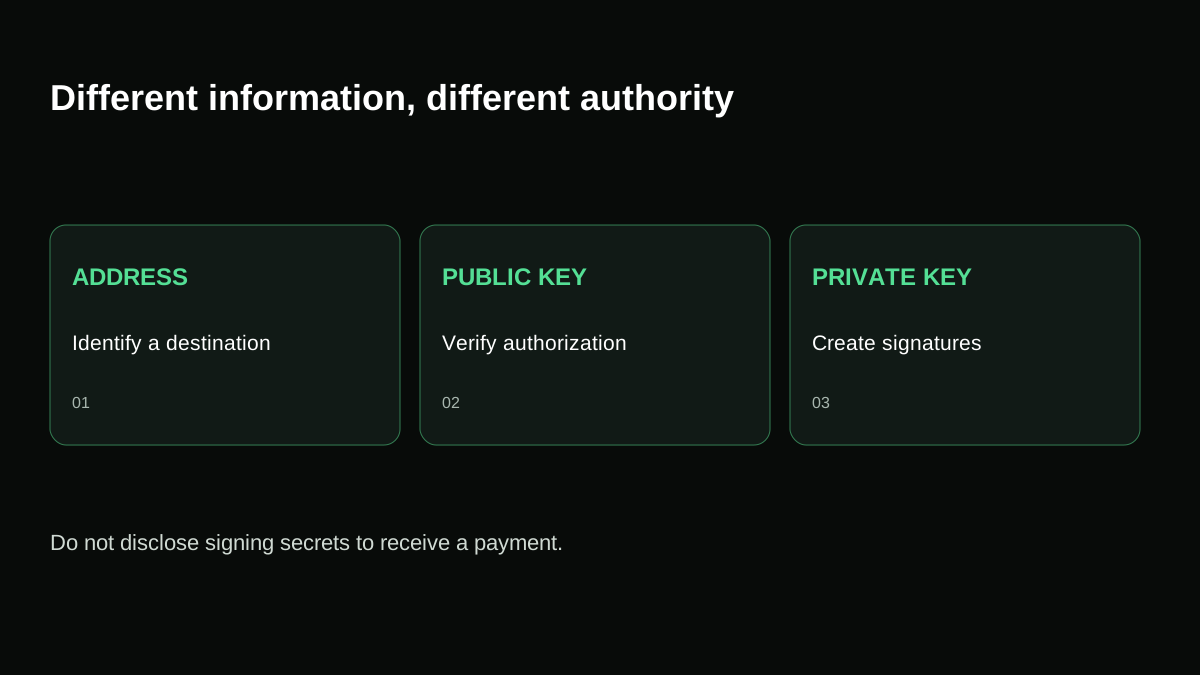
A private key is used to create signatures. A corresponding public key helps verify those signatures. An address is a network-specific identifier derived or constructed according to that network's design. Public keys and addresses should not simply be treated as identical strings.
The wallet usually handles the mathematics. You do not need to calculate keys to receive a payment. You do need to know which information is safe to provide to the payer and which information grants authority.
| Item | Main role | Share routinely? |
|---|---|---|
| Receiving address | Destination or account identification | When needed, with privacy awareness |
| Public key | Signature verification and related protocol functions | Depends on context and wallet design |
| Private key | Signing authority | No |
| Seed phrase | Recovery root for supported wallet designs | No |
These are conceptual roles. Different networks and account types implement them differently. A smart-contract account, for example, may use authorization rules beyond one ordinary private key.
How signing avoids sending the private key
A wallet can authorize a transaction by producing a signature. Network software checks it against the relevant public information and rules. The private key does not need to be sent to the recipient to make the payment work.
That is why requests to “verify ownership” by disclosing a private key are dangerous. The payment system already has methods to demonstrate authorization without revealing the secret itself.
However, a valid signature does not prove the user understood the request. A scam can persuade someone to sign a harmful operation through their own legitimate wallet. Protecting the key and understanding what you sign are separate responsibilities.
Read the transaction or message context. If a website's explanation does not match the wallet prompt, do not substitute trust in the website's branding for an understanding of the action.
A receiving address is public, but not privacy-free
Sharing an address generally does not enable spending by itself. It can reveal activity, holdings or links to other transactions on a public ledger, depending on the network and how the address is used.
Posting it alongside your name may connect blockchain activity to your identity. Reusing a receiving address can make some relationships easier to observe. Privacy therefore deserves consideration even when the address is not a spending secret.
An address also does not prove the identity of the person asking for payment. A scammer can provide a perfectly valid destination. Verify who supplied it through a trusted channel, especially when payment instructions change.
For exchange deposits, the address may not be the only requirement. A memo or tag can be needed to attribute funds to an account. Follow the recipient's current instructions rather than generalizing from a previous transfer.
The same-looking address can exist on different networks
Some compatible networks use similar address formats, and the same account may have the same address text across them. That does not merge the networks or make every exchange deposit compatible.
Before sending, confirm the intended blockchain and asset. The receiving platform must support the route. A correct address on an unsupported network can still result in unavailable funds.
Self-custody recovery may be possible in some cases involving compatible keys and networks, but it is not universal and does not imply a custodial exchange will assist. Do not send more money based on a stranger's promise to unlock a mistaken deposit.
Record payment instructions as “asset plus network plus address plus any required memo,” not as a bare address string. This small habit prevents many ambiguous instructions.
A private key is not the same as your app password
An app password can protect local access or encrypted wallet data. The underlying private key supplies signing authority. If the key has been copied, changing the app password may not remove the other person's ability to sign elsewhere.
A seed phrase can be broader still: in many wallets, it helps derive multiple private keys and accounts. Exporting one private key and exposing an entire recovery phrase therefore need not have the same scope.
Be cautious when a tutorial asks you to export a key. Ask why it is necessary, what software will receive it and whether a supported hardware connection or less-exposing method can accomplish the task.
Simply viewing a balance does not require exposing private keys. A block explorer or watch-only arrangement can inspect public records without signing control.
Respond according to what was exposed
If only an address became public, investigate privacy and unwanted contact. Do not panic and reveal additional information to people offering help.
If a private key was disclosed, assume the associated signing authority may be compromised. If a recovery phrase was disclosed, assume a broader set of derived accounts may be affected. Changing a password or disconnecting a website does not necessarily solve either problem.
Use a clean environment and verified wallet guidance to establish new credentials when required. Where active theft or automated sweeping is involved, obtain qualified help; casually sending fee funds into a compromised address can expose more money.
Keep recovery information out of support tickets. Genuine troubleshooting can usually begin with public transaction identifiers, network information and a description of the problem. No helper needs your seed phrase to inspect a public transaction.
FAQ
Can someone calculate my private key from my address?
Properly generated keys on established cryptographic systems are designed to resist that. Weak generation, stolen backups, software flaws or exposed secrets are different risks. A random direct message claiming to have “decoded” your wallet is not evidence.
Can an address restore a lost wallet?
It can help you view public activity, but it normally does not recreate missing signing authority. Restoration requires the recovery material or arrangement established for that wallet.
Is my private key stored on the blockchain?
Ordinary transactions publish signatures and relevant public information, not the private key. How your wallet stores or protects the secret depends on its design and your setup.
Can I choose a memorable private key?
Do not invent one from a phrase or predictable pattern. Secure generation requires suitable randomness and trusted software or hardware. Memorability is not a substitute for cryptographic strength.
References
Checked November 19, 2026: Ethereum accounts, Bitcoin transactions, Bitcoin wallets and Ethereum security. Next: seed phrases and recovery.